The Free Schools 1700 – 1862
During the latter part of the seventeenth and early part of the eighteenth centuries pious people, anxious to improve the lot of the poorer sections of the Community, established “Free” or “Charity” Schools in many towns. The founding of the S.P.C.K. in 1698 was partly the result of this movement and did much to encourage and further it. “They offered one means of attacking the problem of pauperism that was eating like a canker into the life of the nation.” While some advocate Schools of Industry (Workhouses) others look to the three R’s and religious teaching to give moral uplift and touch the heart of conscience. Needham writing in “Schools and Schoolmasters,” in 1663 says, “It must needs pity any Christian heart to see the little dirty infantry which swarms up and down the alleys and lanes with curses and ribaldry in their mouths, and other rude behaviour, as if they were intended to put off their humanity and to degenerate into brutes.” “Charity” Schools were appointed, and it was estimated that by 1750 30,000 children in England and Wales attended these schools.
Windsor people did their best to alleviate the conditions of the poor children and were early in the field; for in 1705 it was decided that a “Free” School should be established. Before this date John Porter (1701) gave money in his will to a school which was held in Priest Street (now St. Alban’s Street) and this money was used for the Free School when it was established. Also in 1704, Mary Barker left £360 to be shared by Windsor, Egham and Yately (Hants) for the teaching of poor children.
The Trust Deed bears the date November 3rd, 1705 and it was found in the school about 1950, thankfully it has been photographed. A copy hung in the school, another in the Guildhall, but the original parchment, in an excellent state of preservation, was deposited for safe keeping in a Bank (Location now not known).
It reads:
“Tis proposed (if subscription will allow) to do for ye poor children of Windsor the followeth,
- That they may read, write, cast accounts, and be well instructed in ye principles of Religion.
- That they be furnishe’d with Bibles and Common Pr, Books
- That they be be cloath’d in some sort or other.
- That they be plac’d out in the world afterwards 40 boys and 30 girls.”
(The above is on a separate piece of parchment from what follows. It would seem likely that it was a notice displayed to call a Meeting. It is in different handwriting from the rest of the document).
“1705”
“Whereas there is a considerable number of Children in this town and Parish of New Windsor who have little or no education given them, through ye poverty of their Parents; ‘Tis now agreed and resolv’d upon by ye Inhabitants (with whom ye Dean and Canons have likewise expressed their readiness to concur) in setting up a Charity School for that purpose: And accordingly We, whose names are underwritten do subscribe for promoting so pious and useful a work in the manner following”
Some of the names are presumably in the Donors’ own handwriting; but many were written by the scrivener who wrote the introduction.
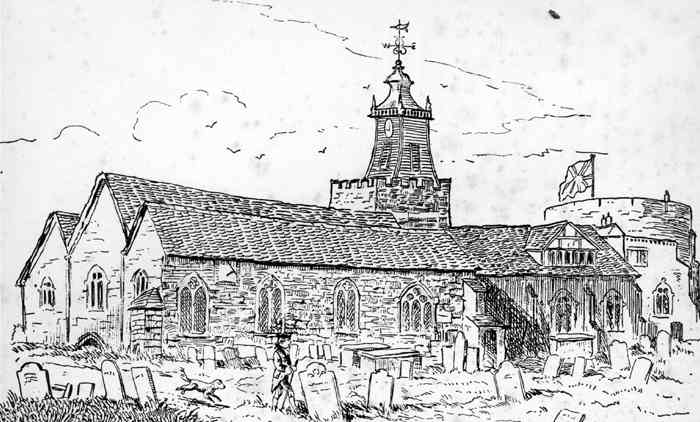
The school building (in the N.E. corner of the Parish Churchyard) was not built until 1725-6. Where the school met for the first twenty years is a matter of conjecture; but probably the Church Vestry was used, and the subscriptions used for books, clothes and pay for the Master and Mistress who were appointed by the Mayor, the Dean and the Vicar. On 30th January 1713, George Pyle, master bricklayer, conveyed to the Trustees some land at Winkfield, the rent to be used for buying bread for “poor, aged and impotent persons” (20s. per year), and the residue towards the master’s salary.
The School Master in 1713 was James Harwood
In 1719 the Rev. Thomas Clever (a Canon of St. George’s) left £4 per year to the Trustees.
“Maintenance and support of the Charity Free School lately set up by the contributions of the well-disposed persons, maintenance and livelihood of present and future schoolmasters”1The Berkshire Record Office D/P149/25/20
There seems to have been some difficulty, however, in providing a building until Mr. Theodore Randue – one of the greatest of Windsor’s benefactors and whose portrait hangs in the Guildhall – died in April 1724 and left by will, dated 5th February 1724, the sum of £500 “to buy or build a house for the school.” The building was started soon afterwards and was completed in 1726. The total cost was £510 0s. 8d., and it contained apartments for the headmaster and headmistress. It is thought that Sir Christopher Wren, who was a prominent citizen at the time, was the Architect but as he died in 1723 this is unlikely. The original document of the Bishop of Salisbury’s faculty dated 23rd March 1724, granting “our licence for the taking into their building a small and useless part of the churchyard…” is in the possession of the Windsor Castle Lodge of Freemasons, who now own the old “Free” School building.
The bill of expenses2 Berkshire Record Office (D/P149/25/20) dated March 30th 1725 for “enclosing part of the churchyard and to erect charity school” purchase and conveyances Thomas Ridding £165:11s:00d total cost £510:00s:08d
There is a Water Colour Drawing in the Royal Collection of the school building about 1726 (incorrectly dated 1705), with the scholars standing round. The masters and boys are in the foreground, and the mistress stands near the door with some girls.
In 1728 Mr W Symonds was the master.
From 1727 to 1815 there were many generous bequests to the school, and by 1819 when the Charity Commission carried out an enquiry, over £4,000 was invested and the school had a yearly permanent income of over £160, besides which H.M. Exchequer made a yearly grant of £24 15s. 0d. this would equal a much greater sum today, and it may be assumed that the trustees had few financial worries. None of this income could be used for apprenticeships; and this was unnecessary for Mr. Randue in his will left £1,000 for this purpose. This Charity was always administered apart from the school and is still in being.
In 1784 came the ladies’ school.
Little is known of the day-to-day life of the school, in 1819 there were about 33 boys and 22 girls in the school. They were appointed by the trustees, and were taught Reading, Writing and Arithmetic, with sewing and knitting in addition for the girls. After making some of the girls’ own clothes, and “the linen for the boys,” the mistress was allowed to take any profit arising from the work done. The part of the Charity given by George Pyle of £1 per year to buy bread for the poor was raised to £2 10s. 0d., half of which was spent on bread for the scholars.
At the beginning of the 19th Century, some of the Trustees were anxious to extend the benefits of the school to a larger number of children and wished to introduce the “Madras” system of teaching by the aid of Monitors (see under “National School”). As far as is known this was not tried. The trustees were the Dean of Windsor and two senior Canons of St. Georges; the Mayor and two senior Aldermen; and the Vicar of Windsor.
Charity Schools generally came to an end before the end of the 18th Centenary, owing to lack of interest, and, in some cases, mismanagement of funds; and were completely overshadowed by the “National” and “British” Schools early in the 19th Century. Here in Windsor the “Charity” School continued for 40 years before amalgamation with the National School.
The 1833 Government schools survey reveals the pupil numbers to be 36 boys and 36 girls.
The 1844 Pigot & Co Directory lists the school with WM Stevenson as Master and Isabella Stevenson as Mistress.
The 1852 Slater’s Directory lists the school with WM Stevenson as Master and Isabella Stevenson as Mistress.
The 1854 Post Office Directory lists the school with WM Stevenson as Master and Isabella Stevenson as Mistress.
On 22nd January 1859 the Rev. Henry J Ellison published a detailed article for the Windsor & Eton Express newspaper detailing the need for, aspirations and purpose of the New School
The Windsor Free Schools – The Rev. Henry J Ellison
By the eighteen-fifties the trustees agreed the need to amalgamate The Free School with The National School into one large new building. By order of the Court of Chancery, dated 25th May 1859, the real estate of the Free School, together with over £5,000 in investments, was transferred to Official Trustees, and a committee of Management appointed. The rent from The National School building with voluntary contributions, grants from Government and the National Society enabled a new school to be built on Maids’ Acre, adjoining Bachelors’ Acre. This land was purchased for £500 and was conveyed to the trustees on 29th September 1861.
The Trustees sold the old Free School building “The old schoolhouse near the Parish Church” by public auction to Henry Darville for the sum of £470. Authorised by Rev. John Ellison 8th November 18613Berkshire Records Office D/P149/25/64. It was to become a Masonic Hall, as it remains today.
The building of the new school proceeded without delay
Great care was taken to ensure that the endowments from the different schools were considered these included, bread to be distributed to poor persons under Pyle’s Gift. Clever’s gift of £4 per year was also provided for. At the same time the National School endowments (including that of the “Ladies” School which had been transferred to the National School in 1819) were applied for the benefit of the new school. Windsor’s share of Mary Barker’s gift (much appreciated) was also included.
The new school was to be called the Windsor Royal Free and Industrial School and was to be open to children aged between seven and sixteen years. A sum of about £115 a year was to be used for providing boots and clothing for the foundation scholars, thirty-five boys and thirty-five girls would be subsidised as Free Scholars (Foundation Scholars), ‘who would be fully clothed as heretofore, and should receive a free education. These pupils would be chosen by the trustees at the annual meeting, from among the children attending the school. In selecting the children, the trustees have regard to good conduct and regularity of attendance of the children and the circumstances of the parents.
Free Scholars:
- Consisting of 36 boys and 30 girls (different figures from different sources),
- Boys: the clothing given annually consists of a suit of clothes, a cap, shirts and underclothing.
- Girls: materials for a dress, a hat and underclothes.
- Each scholar receives annually 2 pairs of boots.
The endowments of the Ladies School were at the same time transferred and “under the direction of the Vicar, the honorary treasurer and a committee of ladies a sum of between £30 and £40 a year out of the income providing 20 girls attending the school with an outfit of clothing in each case on election, a pair of boots at Christmas, and on leaving an outfit to the value of £2 10s. 0d.”
The Champagne bequest to the National School for prizes for proficiency in Religious Knowledge was also transferred to the Trustees of the New School.
The remaining pupils would have been required to pay one or two pence per week.
The ‘Industrial training’ appears to have consisted of gardening for boys and laundry work for the girls.
Was the architect of the new school the famous G E Street?
1861 Letter from the builder Fassnidge & Son Uxbridge dated 3 December 1861 “Progressing as fast as weather will allow”4 Berkshire Records Office D/P149/25/64
1862 New building completed5 Berkshire Records Office D/P149/25/64
See Also:
The Royal Free School 1859 – 1968 Batchelors Acre, Alexander Road and Spital