The History of the Royal Free Schools 1859 – 1968
On 22nd January 1859 the Rev. Henry J Ellison published a detailed article for the Windsor & Eton Express newspaper detailing the need for, aspirations and purpose of the New School
The Windsor Free Schools – The Rev. Henry J Ellison
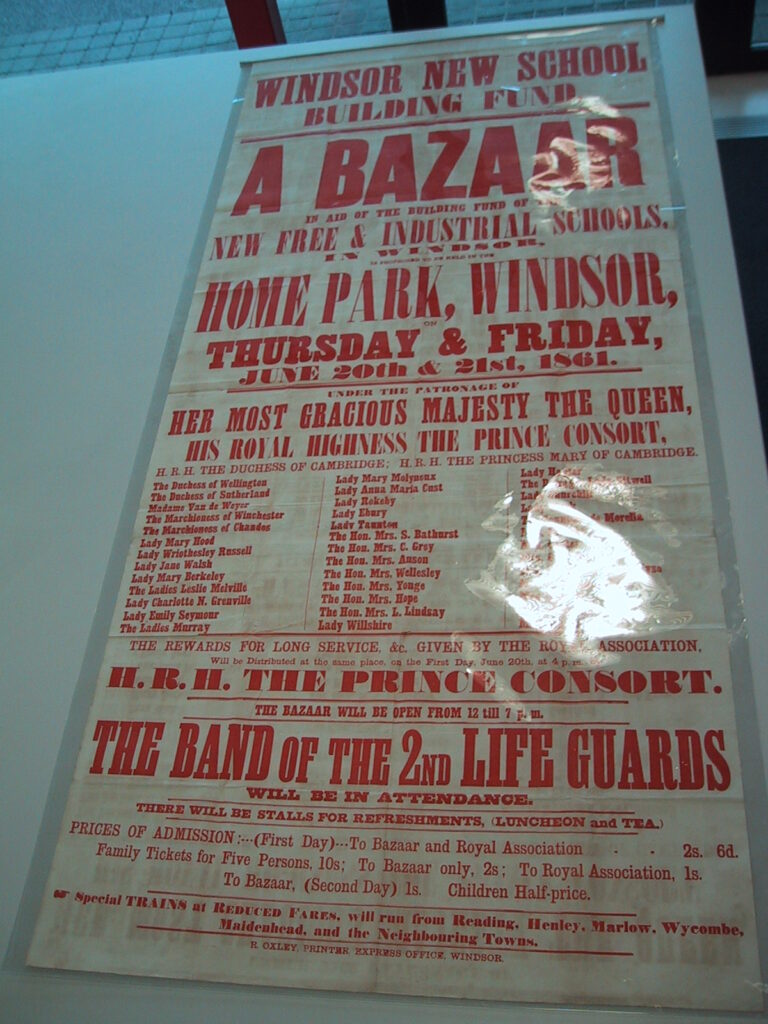
By the eighteen-fifties the trustees agreed the need to amalgamate The Free School with The National School into one large new building. By order of the Court of Chancery, dated 25th May 1859, the real estate of the Free School, together with over £5,000 in investments, was transferred to Official Trustees, and a committee of Management appointed. The rent from The National School building with voluntary contributions, grants from Government and the National Society enabled a new school to be built on Maids’ Acre, adjoining Bachelors’ Acre. This land was purchased for £500 and was conveyed to the trustees on 29th September 1861.
The Trustees sold the old Free School building “The old schoolhouse near the Parish Church” by public auction to Henry Darville for the sum of £470. Authorised by Rev. John Ellison 8th November 18611Berkshire Records Office D/P149/25/64. It was to become a Masonic Hall, as it remains today.
The building of the new school proceeded without delay
Great care was taken to ensure that the endowments from the different schools were considered these included, bread to be distributed to poor persons under Pyle’s Gift. Clever’s gift of £4 per year was also provided for. At the same time the National School endowments (including that of the “Ladies” School which had been transferred to the National School in 1819) were applied for the benefit of the new school. Windsor’s share of Mary Barker’s gift (much appreciated) was also included.
The new school was to be called the Windsor Royal Free and Industrial School and was to be open to children aged between seven and sixteen years. A sum of about £115 a year was to be used for providing boots and clothing for the foundation scholars, thirty-five boys and thirty-five girls would be subsidised as Free Scholars (Foundation Scholars), ‘who would be fully clothed as heretofore, and should receive a free education. These pupils would be chosen by the trustees at the annual meeting, from among the children attending the school. In selecting the children, the trustees have regard to good conduct and regularity of attendance of the children and the circumstances of the parents.
Free Scholars:
- Consisting of 36 boys and 30 girls (different figures from different sources),
- Boys: the clothing given annually consists of a suit of clothes, a cap, shirts and underclothing.
- Girls: materials for a dress, a hat and underclothes.
- Each scholar receives annually 2 pairs of boots.
The endowments of the Ladies School were at the same time transferred and “under the direction of the Vicar, the honorary treasurer and a committee of ladies a sum of between £30 and £40 a year out of the income providing 20 girls attending the school with an outfit of clothing in each case on election, a pair of boots at Christmas, and on leaving an outfit to the value of £2 10s. 0d.”
The Champagne bequest to the National School for prizes for proficiency in Religious Knowledge was also transferred to the Trustees of the New School.
These schools became the Royal Free Foundation in 1859.
The remaining pupils would have been required to pay one or two pence per week.
The ‘Industrial training’ appears to have consisted of gardening for boys and laundry work for the girls.
Was the architect of the new school the famous G E Street?
1861 Letter from the builder Fassnidge & Son Uxbridge dated 3 December 1861 “Progressing as fast as weather will allow”2 Berkshire Records Office D/P149/25/64
1862 New building completed3 Infant School Layout Plan 1899 – Alexander Road Following the move of the infant school to Alexander Road the Woodwork Room of the Royal Free Secondary School were built in 1871 From 1863 we have the advantage of reference to the “Log” Books of the Boys’ School., the Girls’ School logbooks are not to hand until well into the next century. Some of the more interesting extracts from these books: Extracts from the School Log Books In 1859 the title “Royal” is used for the first time, and it is not clear whether this title was given by the Court of Chancery because of the subscription given by Queen Anne to the original foundation in 1705, or because the Royal Bounty which has been received yearly. Both these considerations were probably in the mind of the Court; but it is only since 1859 the the word “Royal” is found in connection with the name of the school. In the 1950 “Older Windsorians” generally assert that it is only comparatively recently that the school has been known as “Royal Free,” and that it was generally spoken of as the National School at the beginning of the present centenary. In the 20’s and 30’s the school football team was known as “The Nats.” However, that may be, the official title of the school since 1859 has been, as stated above, and this has been used on school official documents since that date. Windsor and Eton Express dated December 20th 1867 “The familiar dress so long worn as the uniform of the boys of the Free Schools – blue coat with brass buttons, saucer cap and corduroy trousers – is now changed to a dark cloth jacket, dark grey trousers, and a peaked cap with a narrow red piping round the crown.” 1871 pupil numbers from the first Government Inspection indicate: Infants 220 Pupil E. R. Beasley came to the Royal Free School in 1877, under Mr. Whittington. Discipline was strict- “All late boys queued until after registers were called, then to the headmaster’s desk for the cane. If caught with sweets – confiscated and thrown out of the window, and when playtime came a scramble to get out first and retrieve the sweets. There was a soup kitchen round the corner – boys taking ½d. and their own basin and spoon. I was up at 5.30 a.m. to fetch in the cows from Silver fields (now Alexandra Gardens) and milked two of them before morning school. I left school at the age of 11 after passing the Labour Examination.” It is interesting to note that the British and Foreign Schools Society’s School in Chariot’s Place (British School & subsequently the Education Office) had been built in 1841; . For some 70 years the Royal Free and the British School existed in close proximity – too close, if some of the stories of fights on the Acre are to be believed. Rivalry was natural, and no harm was done; and as far as one can tell the two schools lived together in friendly rivalry, which only occasionally developed into antagonism. Extracts from The Windsor Parish Magazine 1881-2 Extracts from The Windsor Parish Magazine 1886 Extracts from The Windsor Parish Magazine 1887 At this time, 5th July 1898 the school Managers appear to look after more than one school, it is asked if the accounts from New Windsor Spittle CE Infants, the Free and Industrial Infants and the Free and Industrial School can be combined.3Kew ED21-1164
About this time 370 boys & 250 girls: average attendance, 330 boys & 220 girls. endowments £250 pa; the elder girls are taught laundry work; Richard George Knight, master; Mrs E Whittington mistress.
The schools as amalgamated in 1859 were for older children (7 to 16 years). Later the Church built the Infants’ School in Alexander Road, and this was attached to the Girls’ School on the Acre although eventually it had its own headmistress and became quite a separate school.
The Infant School is mentioned in the Boys’ School Log Book in 1870 and in 1871 some very young boys were transferred to the Infants’ School. It would therefore appear that an Infants department was retained at the school until the new building was built in Alexander Road in about 1871.
August 15, 1899, the Department of Education wrote to the managers advising them that my Lords propose a reduction in school numbers from June 30, 1901. Boys from 383 to 341, girls from 314 to 284. 4 Kew ED21-1164
Richard George Knight was head teacher in 1911, and is also on the 1901 census as School Master 5 Gerald Knight family history
A Girls Sunday School was also held at the school “An address by A Y Nutt to Mrs Violet Gee on her retirement as Superintendent of the Girls Sunday School in 1907 includes water-colours of Batchelors Acre, including the Free School where classes were held” 6 A Y Nutt by Norman Oxley
In 1908 the Department of Education advised the schools that they must keep separate accounts for the three schools and suggested the schools be called:
- New Windsor Royal Free and Industrial Church of England School
- New Windsor Spital Infant School
The Managers responded with the proposal to drop the Industrial which was duly accepted in February 1909
In 1909 following a recommendation from the Board of Education the school changed its name to The Royal Free Church of England School, dropping the “Industrial ” (Kew ED21-1164)
On the 8 March 1909 the Board of Education wrote to the Schools advising them of maximum pupil numbers based on their facilities.
The headings read School, Boys, Girls, Mixed, Infant, Total to the left actual to the right proposed.
| School | B | G | M | I | T | B | G | M | I | T |
| Victoria Street | 147 | 112 | 142 | 401 | 147 | 112 | 126 | 385 | ||
| Royal Free C of E | 383 | 314 | 344 | 1041 | 303 | 252 | 303 | 858 | ||
| St Edwards RC | 137 | 137 | 102 | 102 | ||||||
| Trinity P | 117 | 221 | 338 | 109 | 204 | 313 | ||||
| Spital Infants C of E | 251 | 251 | 236 | 236 |
Because of these proposed reductions a request was made to extend the school and thus increase the numbers. These plans were accepted in March 1910 and the numbers increased to:
Boys 365, Girls 301, Infant 303 making a total of 969
A number of letters were exchanged between the Managers and Board relating to the calculations of the room sizes and numbers of pupils allowed, also an objection from a local resident concerning the extension and cost to taxpayers.
In December 1911 new figures were agreed making a total of 989 this number is based on the rough calculation of 10 square feet of floor space per scholar. Dual desks would also be provided.
The building work was completed and approved on 13th September 1913.
Revised pupil numbers of 981 were advised in December 1913.
1915 Miss Louisa Smith, mistress Royal Free Infant School 303 infants7Kelly’s Directory
In December 1920 several letters passed between the Board of Education and the Local Education Authority concerning the repairs required to an outside staircase used by the girls to reach their rooms. From this correspondence we can see an outline sketch of the Girls School layout.
1924 Inspectors Report8Kew ED21-23880Boys School: This is the largest boy’s school in Windsor, in some cases the windows are obscured so that some of the rooms are dark. It is possible to have separate rooms for each standard advantage has been taken of this opportunity for suitable grading to have a good top to the school. The brighter boys in the lower classes are pushed on and it is most satisfactory to find in a school of 320 boys. The staff work well together with very little punishment. Of the 7 assistants 4 are men, also a very satisfactory point in a boys school.
Girls School: The premises for the Girls School are above those for boys, being on the first floor they are lighter and airier. There are 6 classes in 5 rooms. There is an excellent staff consisting of the Headmistress and 6 Certificated teachers.
It is clear that both departments have for many years been doing an excellent work in the town in training children, many from the poorer families, as good public citizens.
1925 Inspectors Report9Kew ED21-23880 Royal Free Infant School
“Good updates were sent on the work in 1910, 1912 and 1914 when the school was in a charge of a very capable Head Teacher who occupied that position from 1892 to 1922. Four of the present assistant staff were trained by her; two of these have served nearly 30 years in the school”
“The attention paid to the comfort and well being of the children have been continued under the Head Teacher who came from 1922 to 1924 and the present Head Teacher who has been in the school a year.”
“The baby’s room (under 5) contains a number of cheap but effective beds that fold up to a small cupboard when not in use, they are laid on the floor and the children in this class sleep on them for the first period every afternoon. This room also contains equipment provided by the Managers, a piano, rocking horse, dolls house and other large toys.”
“At lunch time, about half past ten in the morning, the tables are arranged in about 6 or 8 groups each with 6 or 8 chairs around it. The children place brightly coloured tablecloths on their tables and a vase of flowers in the centre. They have small cheap cardboard plates which are burnt from time to time; on them they have any lunch they bring.”
In July 1932 concern was raised that the School name may be illegal “The premises had no right to the name Royal Free” and quoted a Court of Chancellery order dated 25 May 1859 which stated that the schools situated on the Acre only shall participate in the charity known as “Royal Free”
Inspectors report November 194310Kew ED21-47555
From 1863 we have the advantage of reference to the “Log” Books of the Boys’ School. Those of the Girls’ School are not to hand until well into the next century. Some of the more interesting extracts from these books are included below
1930 is a milestone in the history of the schools.
“March 28th, ’30. – Today sees the close of the career of this schools as an elementary one; on April 1st, 1930, it will be known as a Senior Modern School.”
“April 1st, 1930. – About 100 boys have been passed into the Junior School and 106 (72 from St.Stephen’s 32 from Clewer Green and 2 from Victoria Street) have been admitted.”
The above entry is not strictly correct, as legally it remained an Elementary School until 1944 when it became a Secondary (Modern) School under the new Education Act. 1930 is a milestone in the history of the schools. The ground floor was from then on occupied by boys over the age of 11; and the Senior Girls’ School became a Junior School (7-11 years) for boys and girls. The Senior Girls from 1930 have gone to the Princess Margaret Rose School. This carried out the recommendation of the 1926 “Hadlow” Report. Mr Lutwyche retired at this time, and Mr. Norman Sykes became Headmaster. He remained until his death in 1950, when the present Headmaster was appointed.
In March 1930 a deputation led by Miss M Curtis Headmistress of the Windsor County Girls School met with Officers from the Board of Education to discuss The Ladies School Foundation endowment. (Kew ED 21-23880) It appears Miss Curtis represented the Trustees of the Foundation and wanted to extend the scope of the endowment to include scholarships rather than just clothing.
During 1934 one of the classrooms was extended to create a science lab.
In 1934 the effect of a new up to date building in the town began to affect the roll of the school and by 1938, there were only 150 boys on roll. During this period “Free” Scholars were still elected. These received clothes, and the Headmaster and Mistress were given a small amount each year to spend at their discretion on boots for needy children.
School report October 1934 (Kew Ed 21-23880)
“This Department for Senior Boys was established under the Boroughs scheme of reorganisation in April 1930 it Occupies the premises of the old Royal Free Boy’s School of which to a large extent it inherited the tradition . Five of the original assistant staff and 127 out of the 235 boys first enrolled were at the old school.
The plan of the Authority was that the school should receive the boys of eleven years of age from three non-provided junior schools, and for the first three years after the reorganisation the intake varied, the average being 73. The 1934 draft was however only 58, a decrease being specially shown in the number of boys from Clewer St Stephen Junior School. The number now on roll is 206 the school has accommodation for 280.
Woodwork is taught in what was once the main room of the Victoria Street Infant School
“14 June, 1937. Swimming stopped – suspected pollution”
The school always did well at swimming, and it was a serious drawback when the town “baths” were closed. Arrangements were made for boys to go to Maidenhead Pool, and this still happens; but it is poor “second best” for swimming facilities near at hand, as so much time is wasted in travelling.
November 4th, 1937. – H.M.I. and the Secretary of the Education Committee visited the school to view and discuss alterations and additions to premises under the 1936 Act.”
Proposal from the Borough Education Committee 11 Kew ED 21-47555 to extend the school and build a Gymnasium with dining room and craft room above. To take into account the requirements of the 1936 Education Act and to accommodate Senior Boys from Old Windsor.
The scheme necessitates the demolition of the Junior Girl’s Lavatories, which are of obsolete pattern, and their re-errection in the N.W. corner of the playground. It is realised that the proposal encroaches on the limited playground space, but it should be borne in mind that there are only about seventy girls in attendance at the school. Furthermore, an open space adjoining the school (known as Bachelors Acre) is used by both departments as an adjunct to the existing playground.
It is proposed to install electric light in this school (4 points to each room) and together with minor alterations such as the removal of galleries, additional windows and the fitting up of a science room, furniture fittings and apparatus, the foregoing works are estimated to cost £6,400. The School Managers are to fund 25% of the cost.
| Existing | Proposed | |
| Classroom I | 40 | 40 |
| Classroom II | 40 | 40 |
| Classroom III | 40 | 40 |
| Classroom IV | 40 | 40 |
| Classroom V | 20 | 20 |
| Classroom VI Art | 40 | 20 |
| Classroom VII Science | 40 | 40 |
| Gymnasium | ||
| Craft | 40 | |
| Handicraft | 20 |
“February 12th, 1940. – At 2.30 p.m. the New Gymnasium and Art and Craft Room was blessed, dedicated and opened by the Lord Bishop of Buckingham….”
In 1938 Old Windsor Boys and in 1939 Braywood and St Edward’s R.C. boys started to be transferred to the school at 11 years of age.
1939-45. During the War the schools’ history was similar to that of most other schools. Windsor was in a “reception” area. and schools from East London attended the Royal Free. There were many changes of staff. Air Raid Precautions; blackout difficulties; Gas mask drill, etc., were a daily problem. The school was used as a Rest and Decontamination Centre. On 24th October 1940, during the night, the building was slightly damaged by a bomb, which fell at the rear of the premises.
School report October 193412 Kew Ed 21-23880
“This department which was organised in April 1930 for the teaching of junior children from eight to eleven years of age occupies the premises of the former girl’s department of which for some twenty years the Headmistress had charge. The school began its new career with some 300 children. Up to 1933 there was a small yearly decrease in numbers, almost wholly confined to the girls, but this year both boys and girls are fewer in number and there are now 136 boys and 79 girls in attendance”
School report July 194313 Kew Ed 21-47555
The headmaster has recently returned from war service and in his absence the Head Assistant Mistress has been in charge. There have been the well-known wartime disturbances evacuees, changes of staff and limitations of school equipment. The organisation of the school is somewhat complicated. The practical two stream system which existed five years ago has been given up. At present about 50 juniors enter the school each year and this means that arrangement have to be made for more than one class.
During the war years Boys from the Dr Barnardo’s Home at New Lodge Winkfield were bused to the Royal Free School.
Royal Free at Batchelors Acre legally remained an Elementary School until 1944 when it became a Secondary (Modern) School under the new Education Act. 1930 is a milestone in the history of the schools. The ground floor was from then on occupied by boys over the age of 11; and the Senior Girls’ School became a Junior School (7-11 years) for boys and girls. The Senior Girls from 1930 have gone to the Princess Margaret Rose School. This carried out the recommendation of the 1926 “Hadlow” Report.
On 27th March 1945 the school became a Secondary (Modern) School. This had no immediate change on the working of the school. When the leaving age was raised to 15 a prefabricated classroom (H.O.R.S.A.) was provided in Sun Passage to accommodate the extra age group. The Windsor (Pt.III) Local Education Committee disappeared and the Berkshire C.C. became the Education Authority, with a Divisional Executive Committee serving the Royal Borough and the Windsor Rural District.
In 1952 the Governors agreed to the Secondary School having “Controlled” Status, briefly this means that the Governors are no longer responsible for the upkeep of the building in any way, all this being done by the Berkshire Education Committee. The Governors, on their part, had to give up certain rights in the matter of Church Teaching; although provision is made for any boy, whose parent’s requests, to have this teaching in addition to the Religious Education which is given in all schools in the Country under the 1944 Education Act.
The Junior School, however, has “Aided” Status, and thereby continues very much as it has done in the past.
Effects of the Act have become more gradually apparent; Grammar Schools became non-fee paying, and this has meant that all boys capable of profiting by an academic Course are admitted to Grammar Schools, and thus the “Studious” type of boy is not so often met in the “Modern” Schools as was customary in the old Elementary Schools. Our boys today (1955) are interested in practical subjects; and practical approaches to traditional subjects are more likely to obtain good results than the more formal methods of some years ago. This must be remembered when any comparison is made with standards of former days.
In 1955 the School was 2-form entry, and the roll has risen in recent years to about 280.
1956 Instruction to implement the 1944 Education Act
The following contributions from the boys in 1955 will give some idea of what life today in the Royal Free Secondary School is like; but one or two comments on happenings of the last few years may be worth recording briefly.
Games and Sports. – The School is keeping up its tradition, Results of successes appear in the boys’ contribution. But what is even more gratifying is that boys, who are not so good at games, are encouraged to join in, and usually become enthusiastic and enjoy their games, although they may never excel at them. Physical Education today certainly caters for everyone and does not concentrate on the School Team to the detriment of the other boys. These activities are carried on in the most difficult conditions.
Gardens. – In 1949 some rough, waste ground belonging to the Borough Council was taken in hand by the boys; and this has gradually been extended so that in Summer the passer-by along Sun Passage can enjoy the sight of pleasant gardens instead of Rubbish Dumps.
Coronation. – The boys made a present to the school to commemorate the Queen’s Coronation. It was an oak lectern (made in the Woodwork Room) with the school crest carved on it. Whatever the future of the school may be this will be a reminder of 1953 to future Royal Free Boys. Two trees were also planted; but who can guess the future of them in Sun Passage.
The School Crest. – Was designed by Mr. E Halliwell, Art Master, in 1951. We are proud of this; although we were disappointed in having our application for permission to use a crown refused by the Home Secretary.
“Open” Afternoons. – Instituted in 1951 are gradually becoming appreciated by parents, who are asked to come and spend time in the school whilst it is in session.
Visits. – Apart from visits to places near at hand, such as the Borough Council Meetings; St Georges Chapel; factories in Slough, etc., visits to Ford’s Motor Works; the Palace of Westminster; Kew Gardens, etc., take place every year. These arise out of the Schemes of Work. More ambitious School Journeys to S. Wales lasting four days are also made; and in 1952 during the Easter holiday a party of 40 boys spent a week in Paris.
Speech Days. – During recent years the school has been fortunate in having as its chief guests some well-known people- The Headmaster of Eton; The Dean of Windsor and Sir Sydney Camm.
In conclusion it is hoped that this Sketch will be found interesting to Windsorians generally, and to Royal Free Boys, both old and young, in particular. The future of the building is uncertain. It should have been rebuilt on another site in 1950; today it is assumed that this will not take place in the “foreseeable future.” When the time comes I believe there will be some regret at leaving the Acre, although all will be glad to have more modern premises with proper playing fields (the schools’ greatest need.)
But the future of the school is assured. It will flourish wherever its buildings may be. The traditions of the past 250 years will be an inspiration to many future generations of Royal Free Boys; and the school will continue its work of educating boys, who will “be placed out in the world afterwards” having a sure foundation off sound learning and good behaviour.
Everyday life – additional contributions from the pupils attending the school in 1955
THE SCHOOL SONG
“Down through the years our School has still
Maintained its high tradition
Of serving others, working hard,
And setting high example.
We may not reach the highest spheres,
But yet we can our part fulfil,
By selfless thought and ready help
To Borough, Queen and Country.”
(Part of the school Song, written by Mr. E. J. Steel, 1948-53)
The new Royal Free Secondary Modern School for Boys was built at Bourne Avenue and opened in 1967/68 some of the boys helped with the move during the Easter to Summer period. One of the main advantages of the new school was the inclusion of a large sports field.
The vacated space at Batchelors Acre was given over to the Royal Free Junior School.
See Also:
1700 – 1862 Free School (St Albans Street, Church Lane)
Additional Information
Windsor and Maidenhead schools guide The Berkshire Record Office