Windsor People
The Knight Family
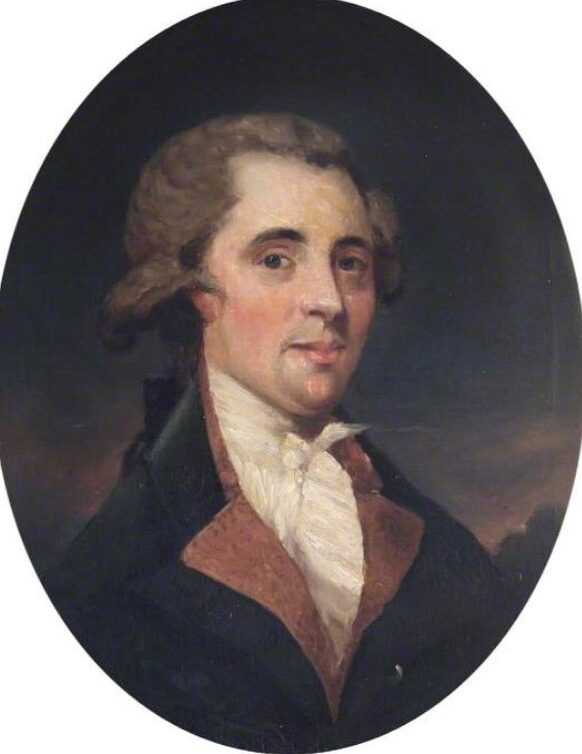
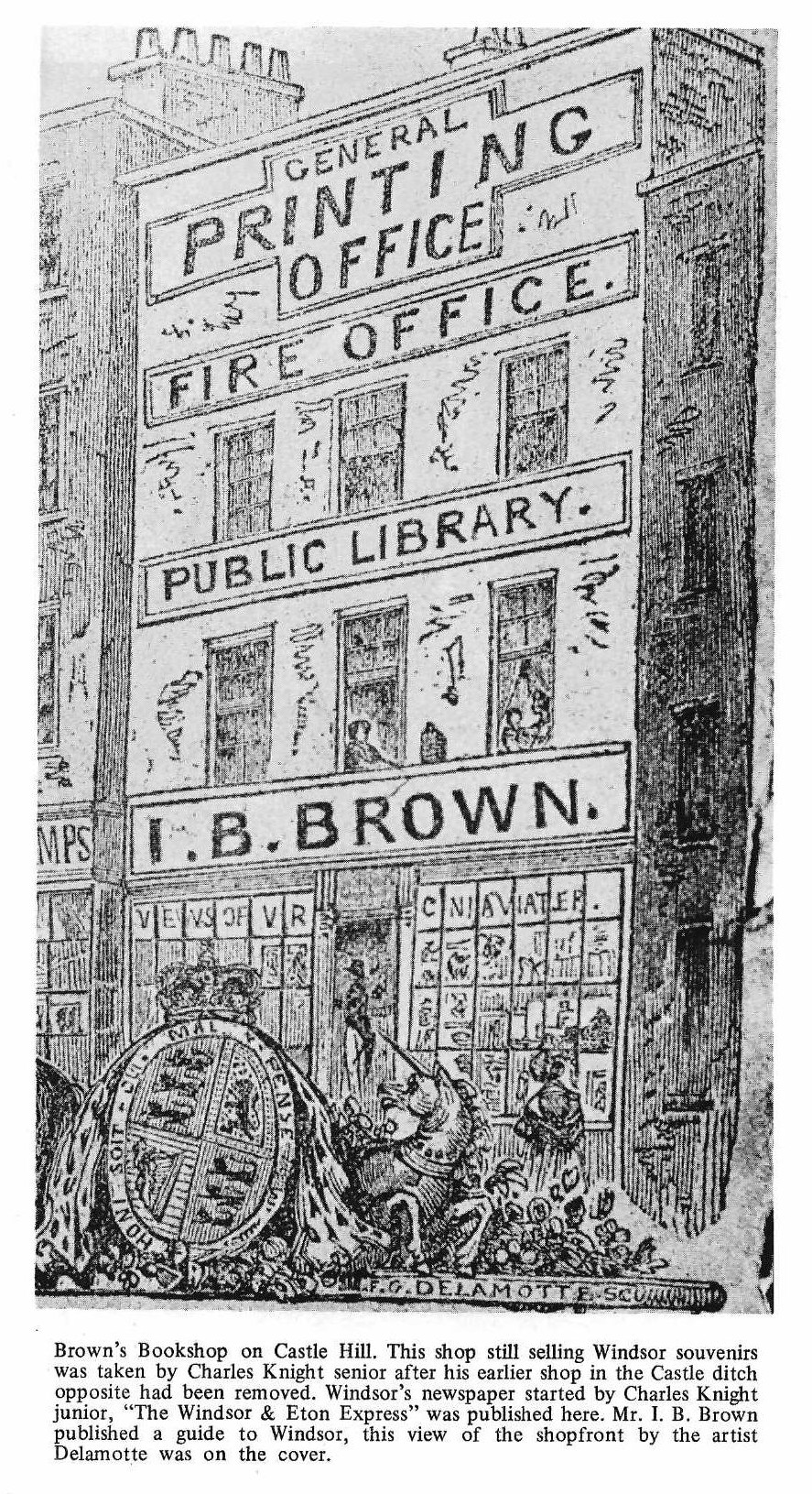
Charles Snr, had settled in Windsor in 1780. He was a bookseller, printer and author. On 31st March 1785 he published his first Windsor Guide, his local guide-books passed through many editions for half a century. He was twice Mayor (1806 &1817) Alderman, Justice of the Peace and Bailiff. The family lived above the shop in Castle Street, at first in a house very near to the Henry VIII Gateway, and then in more spacious accommodation. Knights Bookshop moved to 2 Castle Hill in 1800.
In 1780 Charles Knight Snr had voted for Admiral Keppel for Parliament, in spite of the Kings preference for his rival, and he was active in the affairs of the parish and Corporation. (Keppel estates – large land owner in Windsor)
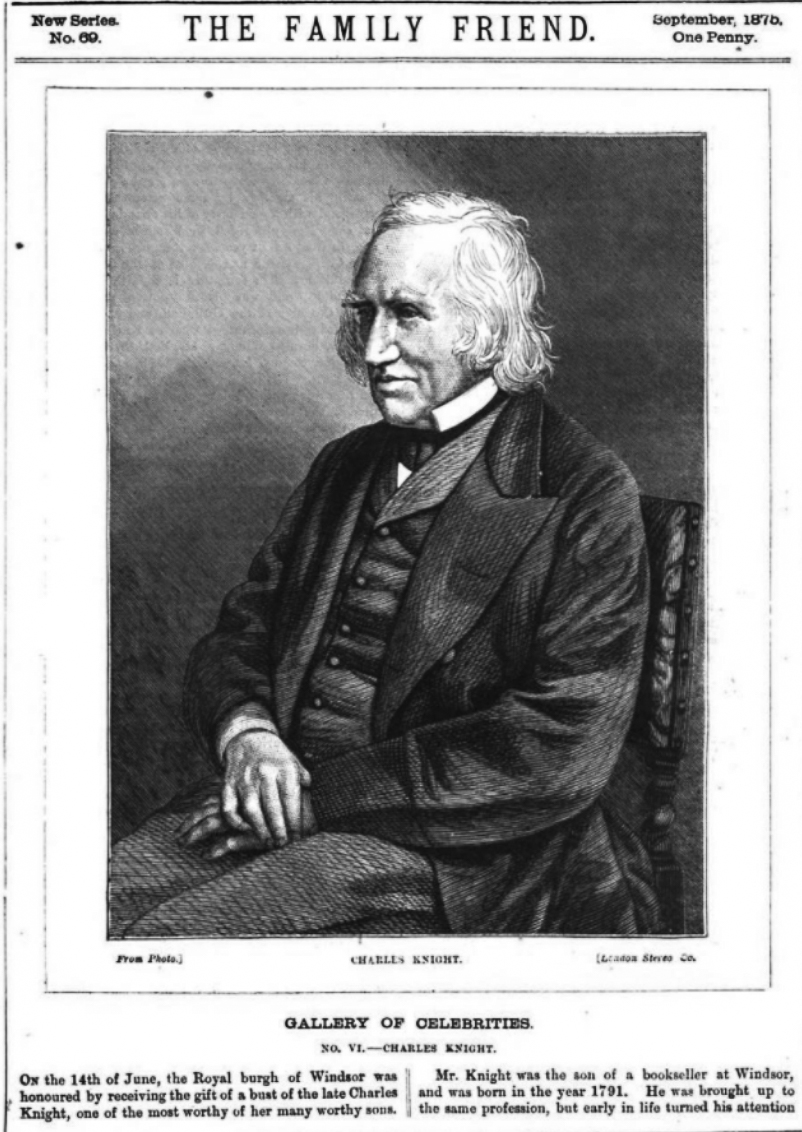
Writer, publisher and philanthropist, was one of Windsor’s most distinguished citizens.
Young Charles Knight recorded how, between May and August 1802 three hundred thousand “Volunteers” , Home Guard, were enrolled in the country. The summer was the time of marching and counter-marching’s, and he described how a Volunteer had to prepare his person for an exercise. First, he had to pipe-clay his white breeches and gaiters, and he had to polish the bright barrel of his musket till he could see his face in it. Then he had to grease and flower his hair like a footman.
Charles Knight’s reminiscences are amongst the best descriptions of Windsor at the beginning of the 19th century.
Charles relates how the King would drop in to his father’s bookshop on Castle Hill and recalls the morning when his father came downstairs and was horrified to find him reading Tom Paine’s Rights of Man.1The Book of Windsor – Raymond South
His childhood memories published in Passages of a Working Life (1864) paint a vivid picture of the town of his boyhood, contrasting the comings and goings of royalty with the problems of poverty and insanitariness then.
“The misery of the poor in my native town at the beginning of the century was sufficiently visible even to my childish apprehension. The poor demonstrated against the price of bread, a furious mob gathering at the junction of the streets near the market-place … They had smashed windows of several bakers in the lower part of the town. They believed, as the greater number of people everywhere believed, that the high price of corn was wholly occasioned by combinations corn-factors, meal-men, millers, and bakers. The mob attacked the bakers shop next door to the Knight home. He cared little if his door were forced, his loaves stolen, provided the heavy box under his bed were safe. That box he more than once showed me, was full of crowns and half crowns, with shiny bright guineas, which he had long hoarded … My father from his window exhorted the people to go home. I stood trembling behind him, and was somewhat astonished to see how powerful was the influence of firmness kindness in turning aside the wild but unpremeditated excitement of unhappy and ignorant men, who were not without a sense of justice even in their anger”.
“Never was there such a sink of impurity as my native town. In Bachelor’s Acre the ‘little victims’ played by the side of an open cesspool, kept brimming and overflowing by drains disgorging from every street. The Court sniffed this filthy reek. In the fields around Frogmore tainted the cowslip and the hawthorn blossom. Municipal or royal dignitaries never interfered to abate or remove the nuisance.”
On 25 October 1809, when 50 years of the King’s reign were celebrated in Windsor’s streets, George III, having by then lost his sight, was unable to join the festivities. “The morning was ushered in by the discharge of cannon, ringing of bells etc.”, Cornelia Knight wrote when she described the events in her journal. “Afterwards to Mrs. Duval’s to see the ‘feu dc joie’, and the troops march past — horse artillery, Blues, Stafford, Windsor, and Clewer volunteers
An ox was roasted whole, and two sheep, at a place called Bachelor’s Acre. The Queen, the Princesses, and the Royal Dukes went to see it, and tasted the beer and pudding.” Charles Knight (Junior) wrote that he dressed in a “costume of blue coat, white waistcoat, knee-breeches, and silk stockings, to present slices of the ox on a silver salver to the Queen and Princesses”. In the evening Cornelia Knight accompanied the Royal party to Frogmore for supper and to see the fireworks. One thousand three hundred tickets had been sent to guests: “The Queen’s party was about ninety, consisting, for the most part, of ladies and gentlemen of the neighbourhood who visit their Majesties at the Castle… Things were not well managed in the gardens, but supper and all the arrangements in the house were very pleasant”.
In 1812 the printer of Castle Street and his more famous son collaborate in producing the first issue of the Windsor and Eton Express. Charles Knight the younger was then only nineteen, “a delicate youth with thoughtful blue eyes”, as his granddaughter, Alice Clowes, tells in her biography, but already mature in that faculty for acquiring and diffusing knowledge which was to make him a pioneer in the production of literature for the people. As a child he had shown an unusual eagerness to learn, and the very ardour with which he probed life wrought an early pessimism which troubled his boyhood years. But with the founding of the paper and his entry into the sphere of public work which journalism entails, this vanished: The· first issue of the Windsor and Eton Express, to recall its original title, was published on Saturday, 1st August, 1812, price sixpence halfpenny. Alice Clowes, referring to its foundation, says that her grandfather “continued the editor for fourteen years”, which implies that he and no other was responsible for that first leading article in which, with the humility born of-good sense and sincereness of purpose, the policy of the founders was defined. · “Their merits”, he wrote “will be estimated in the progress of their labours; when they trust they shall not be found undeserving the rewards of unwearied industry, acting upon local and patriotic principles in their political views, and with an earnest desire of being useful in all they furnish of general and local information”. The small, four-page paper published on a Saturday evening, reflected these aims in a range of features which included “The Political Inquirer”, Court News, local news, advertisements and a reference to European affairs at that historic moment, when Napoleon, after the delays imposed at Vilna and Vitepsk, was pursuing the Russians in their retreat towards Moscow.
In June 1820 Charles accepted editorship of a London weekly, The Guardian, loosening his connection with Windsor he continued as editor of the Express until 1827 and in 1830 he finally moved away.
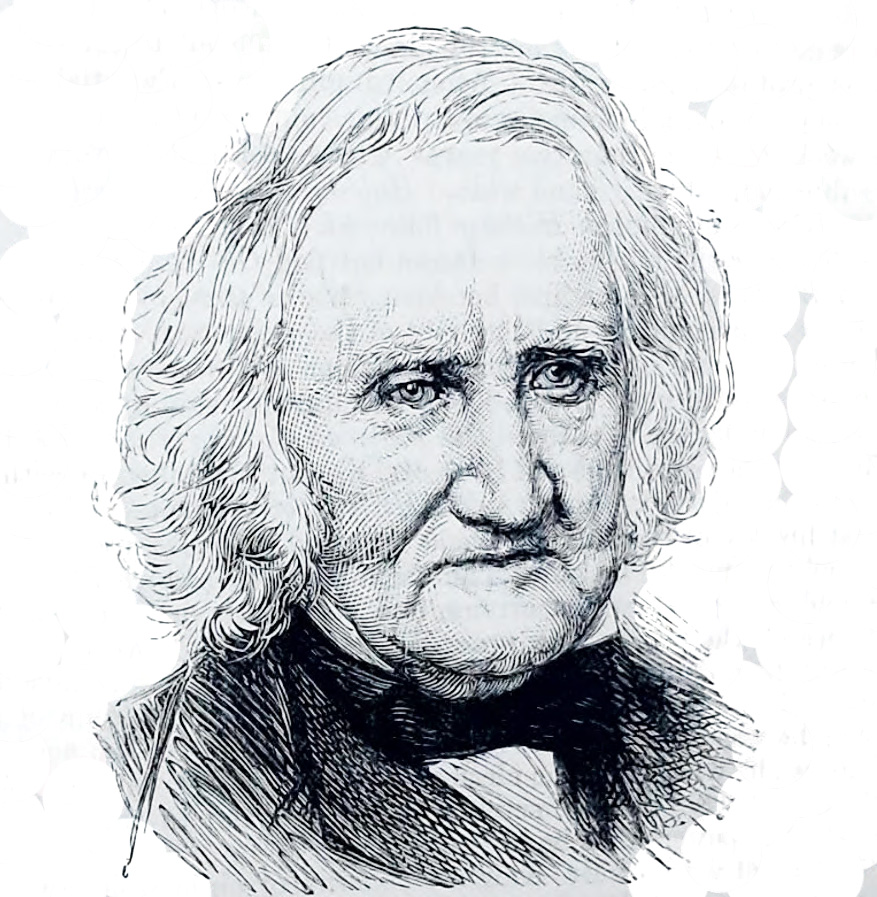
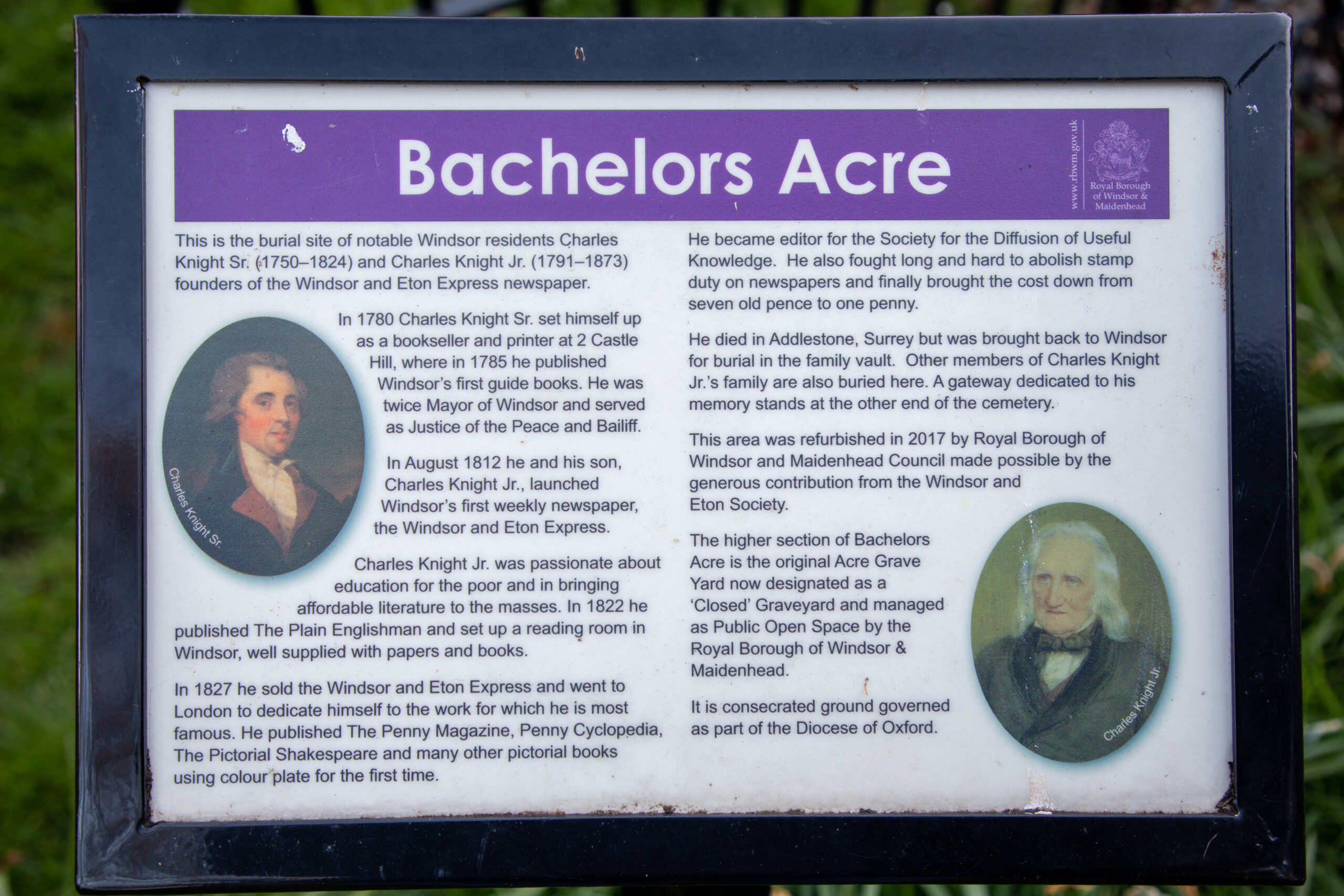
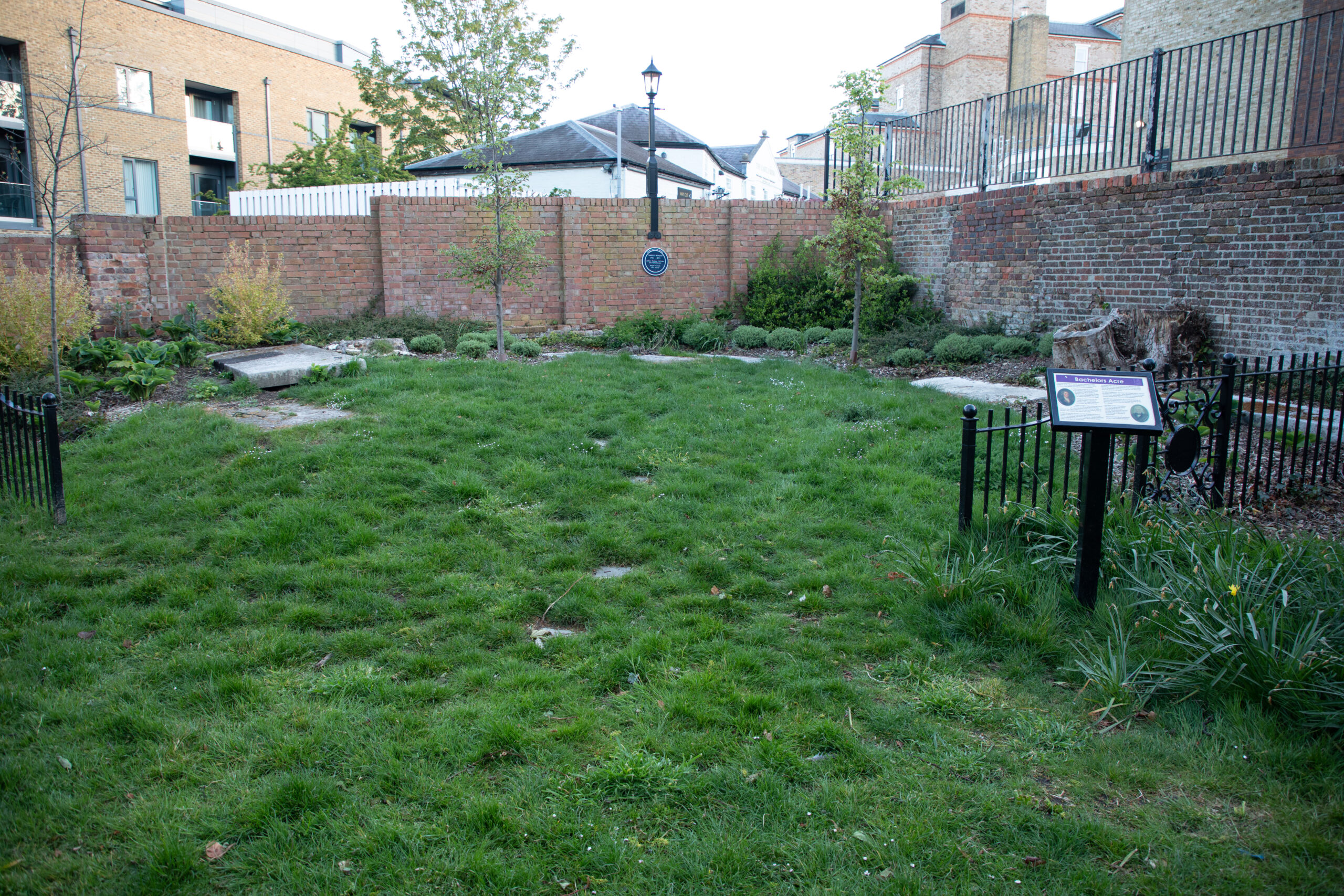
Charles Knight was a man of social conscience who believed passionately that good quality reading matter should be available to all, not just the better off. He was placed in charge of publications for the SDUK (Society for the Diffusion of Useful Knowledge, founded 1826). For them, in 1832, he launched The Penny Magazine, a well-written, well illustrated weekly, priced within reach of all but the poorest. Many working men passed it one to another. Knight’s vision and enterprise led to many other series, including the Pictorial Bible, Pictorial Shakespeare, and a Library for the Young. When he died (at Addlestone) in 1873 his body was brought back to Windsor for burial in Bachelor’s Acre, where gates erected in his memory can still be seen. A plaque marks his grave.
Bachelors Acre Madeira Walk Graveyard
Charles Knight Snr and Jnr are buried in the small closed Graveyard at Batchelors Acre appropriately close to their roots in Windsor. At one end is a wrought-Iron gateway erected by Mr Barry Knight to the memory of his father.
Charles Knight Jnr Obituary in The Windsor Parish Magazine 1881
Charles Knight of Windsor – Local history Group
Bachelors Acre and Madeira Walk Graveyard
The Windsor Guide 1785 Published by Charles Knight ©The Royal Collection Trust
Passages of a working Life – Charles Knight
Windsor & Eton Express – The Oxley Years
In 1827 a young man named Richard Oxley came to Windsor and entered Knight’s employ. Eight years later he became sole proprietor of the Express and the printing and stationery business carried on conjointly with it, and he directed affairs himself for fifty-six years. Then he took his son, Frederick, into partnership with him, and when nearing ninety retired to Hove because Windsor ·did not agree with him”.
By that time the printing works had been established on Bachelors’ Acre for over half a century. The little range of buildings where the Express was produced until 1908 still huddle on either side of a narrow, crooked alley opening into the eastern corner, and farther up the passage is the loft where Mr. Richard Oxley kept the pigeons which brought the results of Ascot Races to his premises, from where they were telegraphed to London. These buildings, low, dark and primitive, are haunted by ghosts of the old days, when the paper was printed on a hand-press, superseded in time by a tumbler” machine for which men· were hired to turn the handle on press-day. “The great engine’, as Thackeray called the news-world, the “great engine” that “never sleeps”, was perforce a very patient, leisurely engine outside London and the larger towns. Like most other provincial weekly newspapers, the Express was set entirely by hand until the early part of this century, and it was already being produced in the modern works lower down the Acre before that old, laborious process became a thing of memory.
The Express passed in time to Richard Oxley’s grandson, the late Mr.
Stanley Oxley. The family still owns it, and this long tradition, and the production of the paper on Bachelors’ Acre for well over a century, serve to illustrate with peculiar aptness the continuity of Windsor history. Yet to recall its origin and record is not to indulge in retrospect of a purely local import. It is a reminder of the mission fulfilled by long-established weekly newspapers in social history, and, incidentally, of what is owed to men of the initiative and energy of Charles Knight.
He himself found his life work through it. “I am full of hope in this and all my pursuits”, he wrote to Sally Vinicombe, who became his wife, and for nearly fifty years he continued writing and publishing, giving to an eager public not only cheap periodicals of literary repute but the first inexpensive editions of histories, encyclopaedia and standard works. Apart from this, he was a kind and delightful personality, a shrewd judge of literature (he was among the first of that discriminating society now classed as the “Janeites”) and a pleasing correspondent to whom such as Dickens and de Quincey wrote some of their most readable letters in return. Although he left Windsor, he continued to have a cottage “there, and he and his wife are buried somewhere in the old graveyard above the Acre.