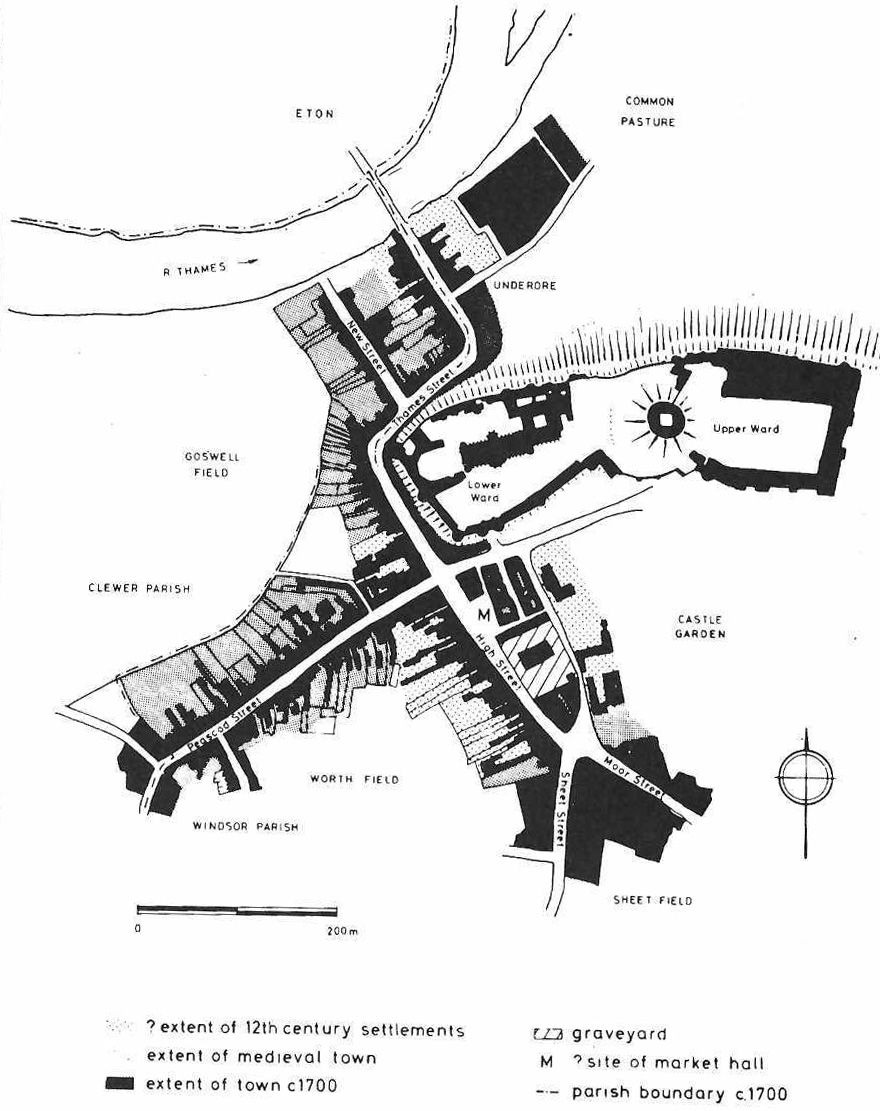
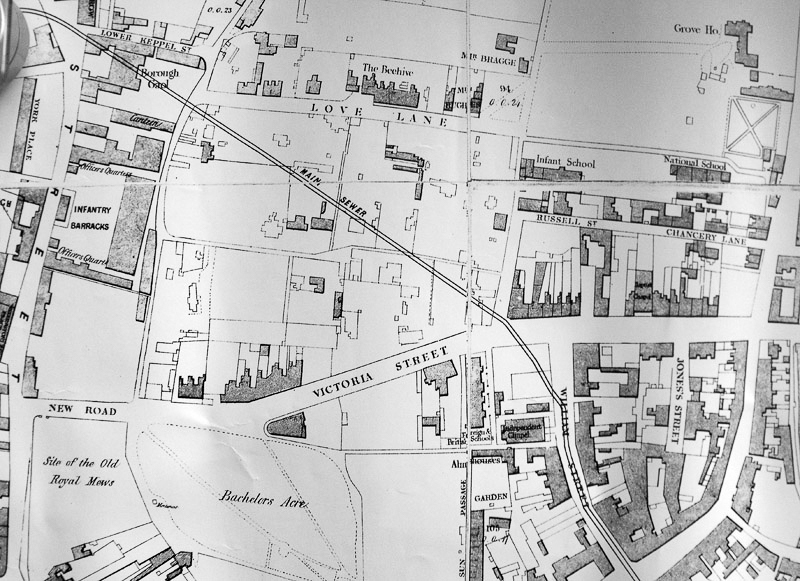
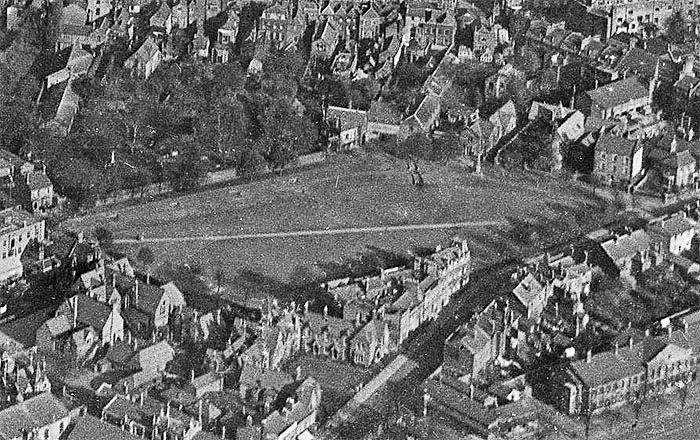
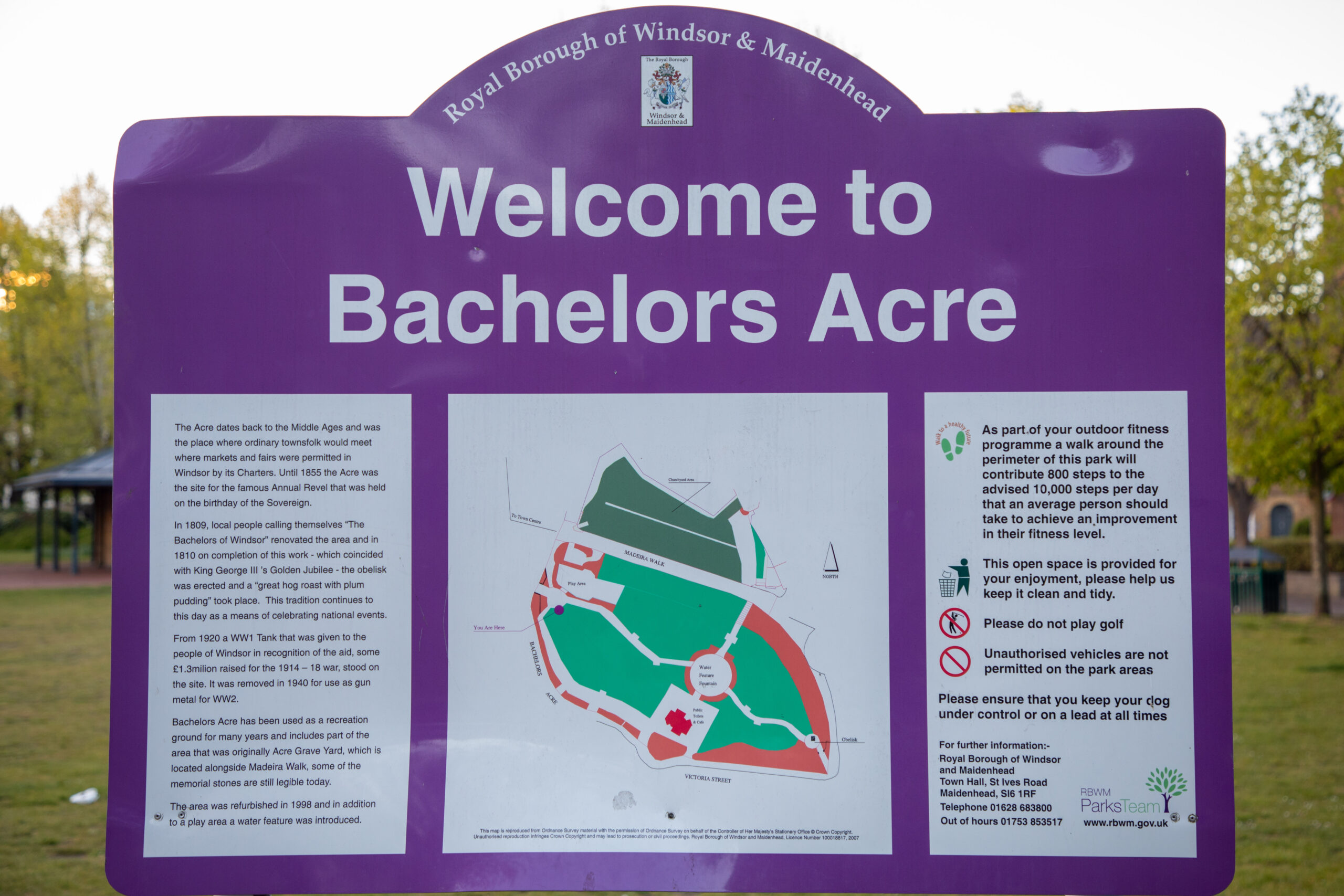
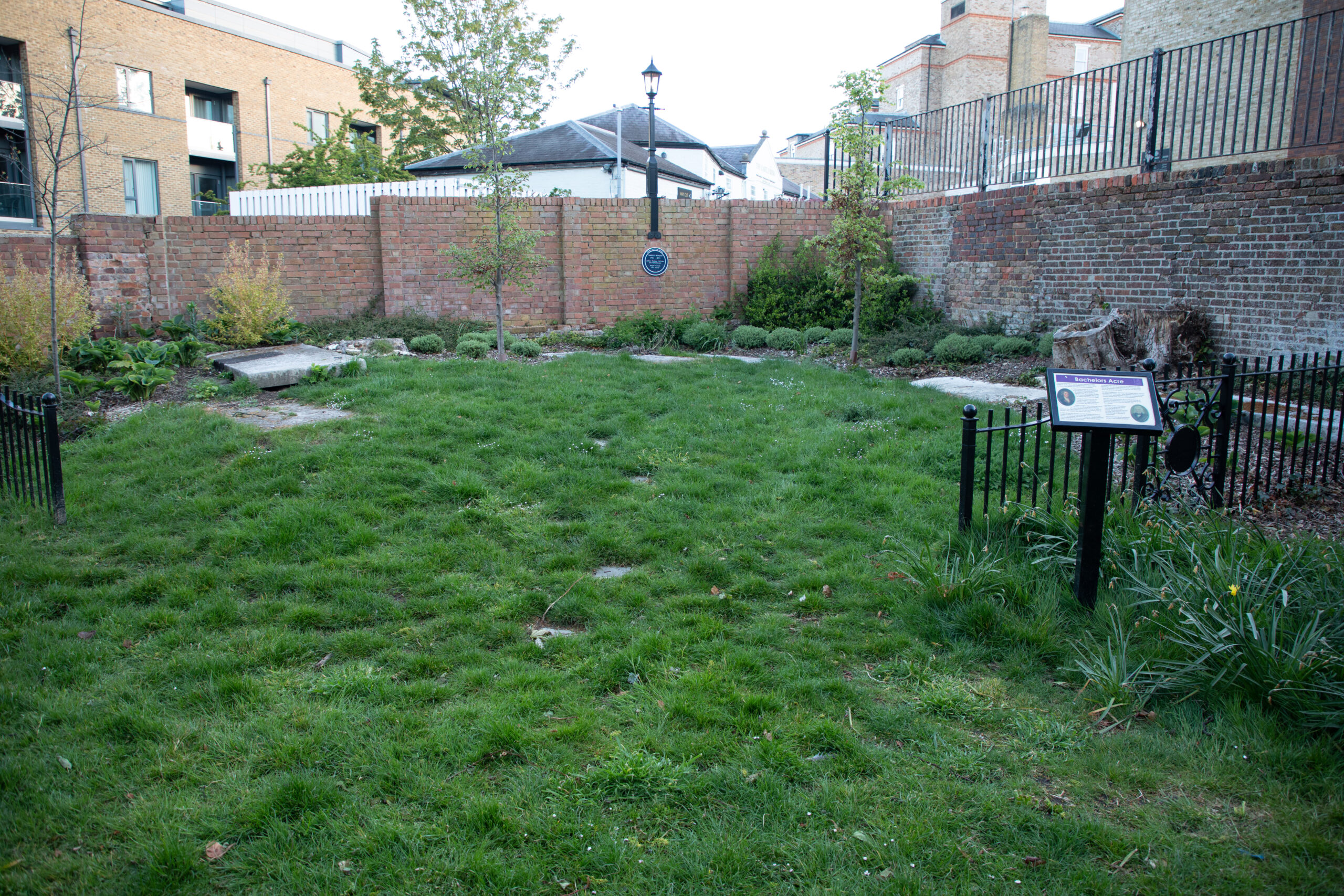
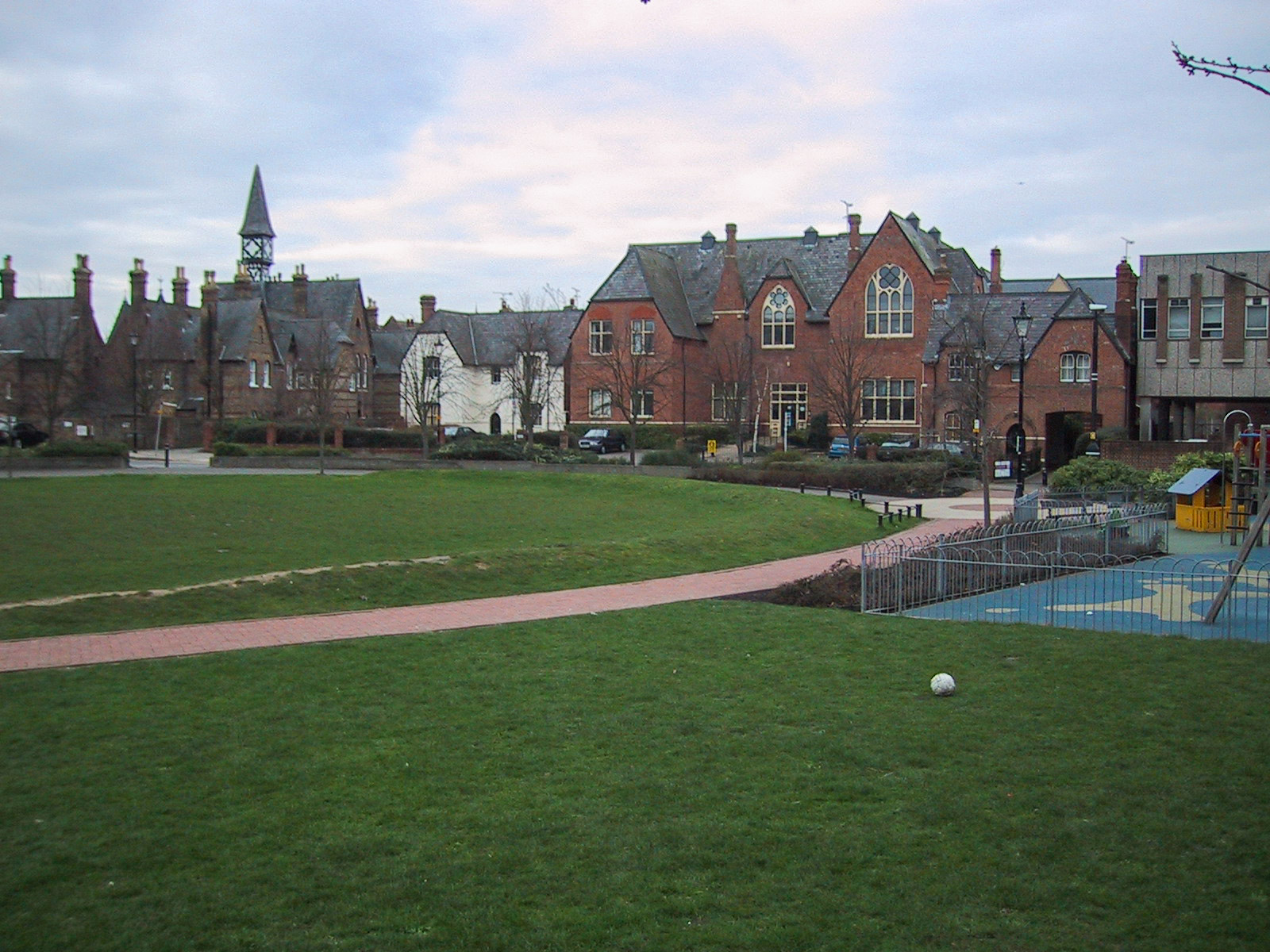
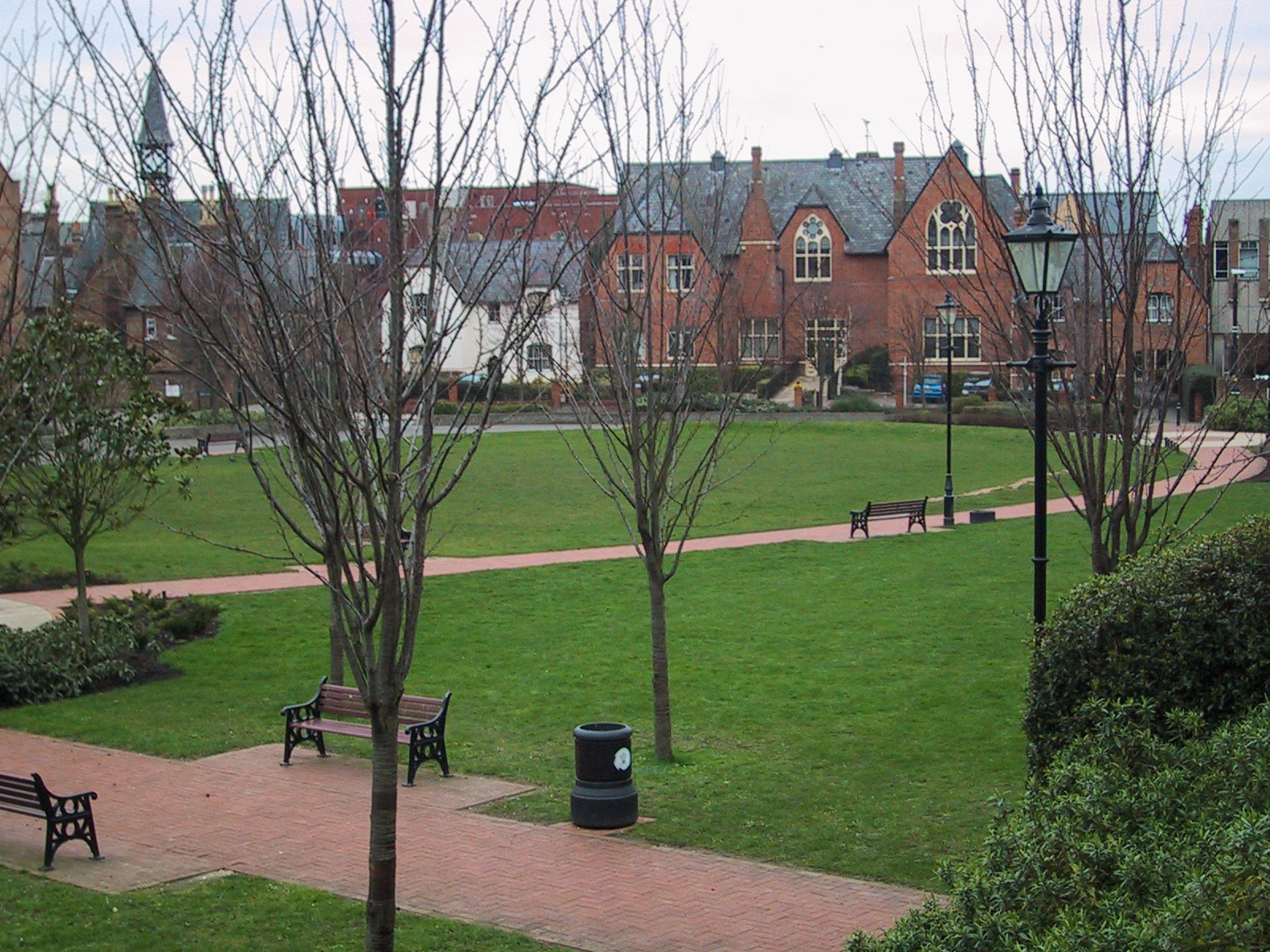
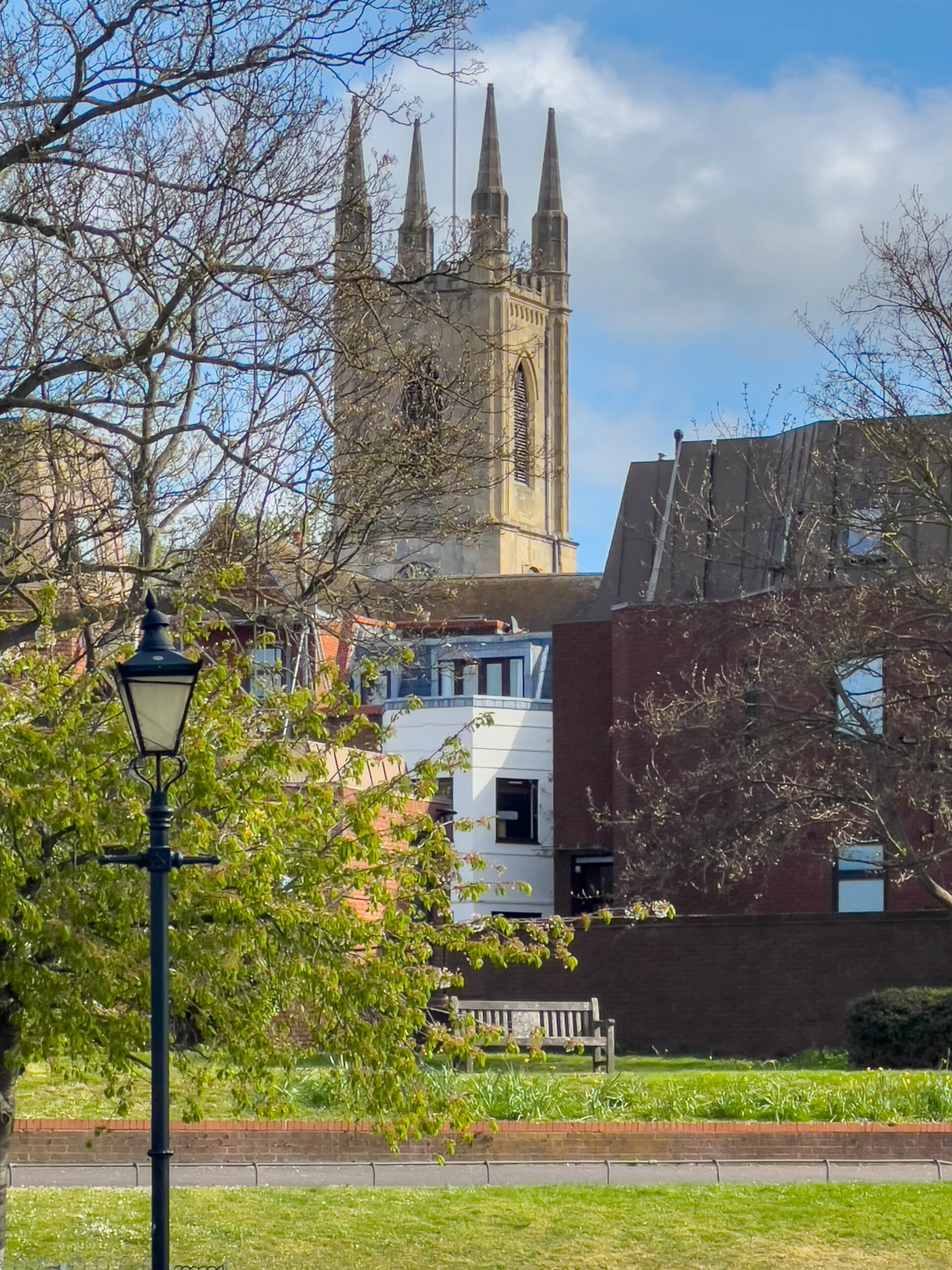
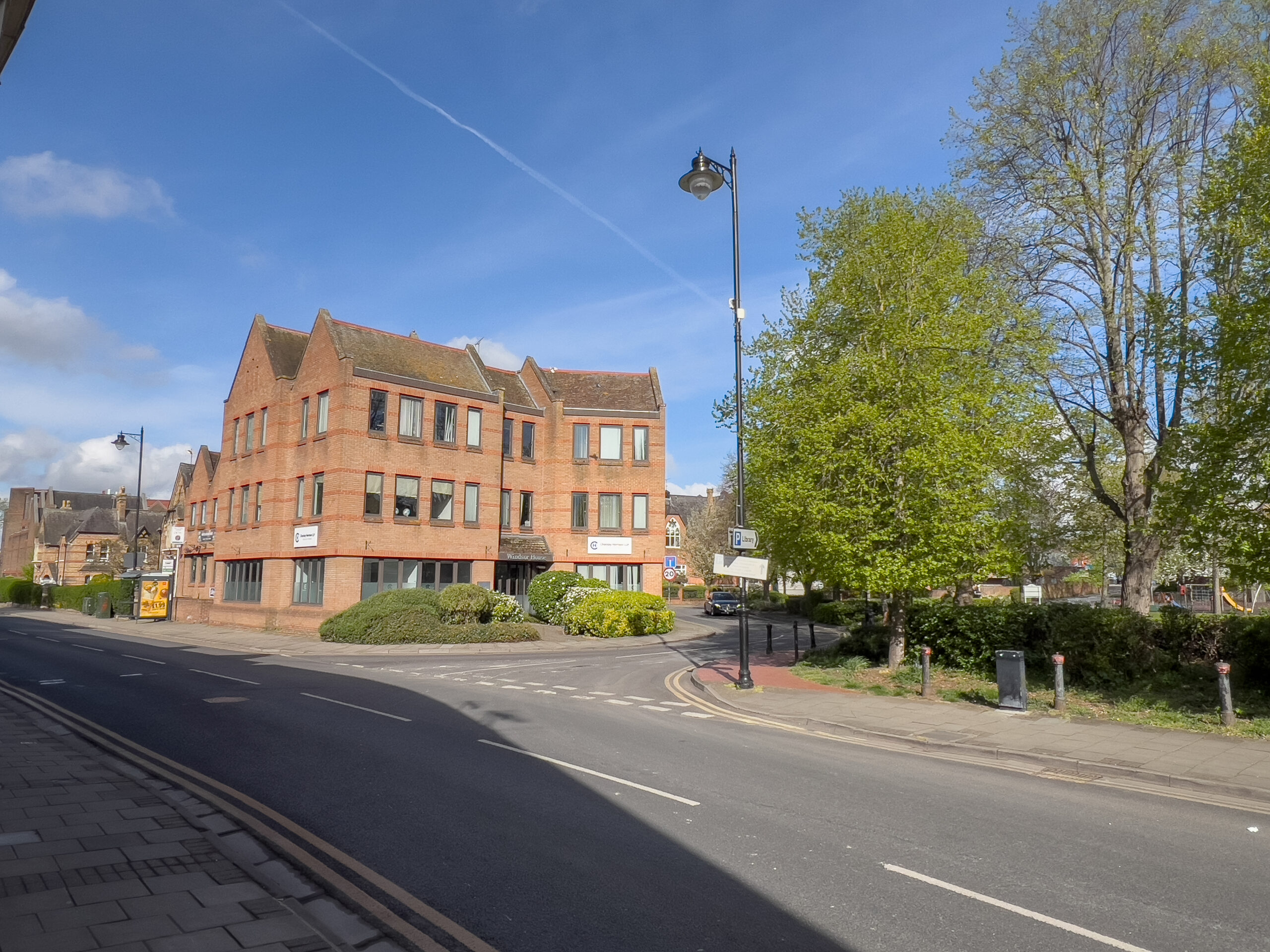
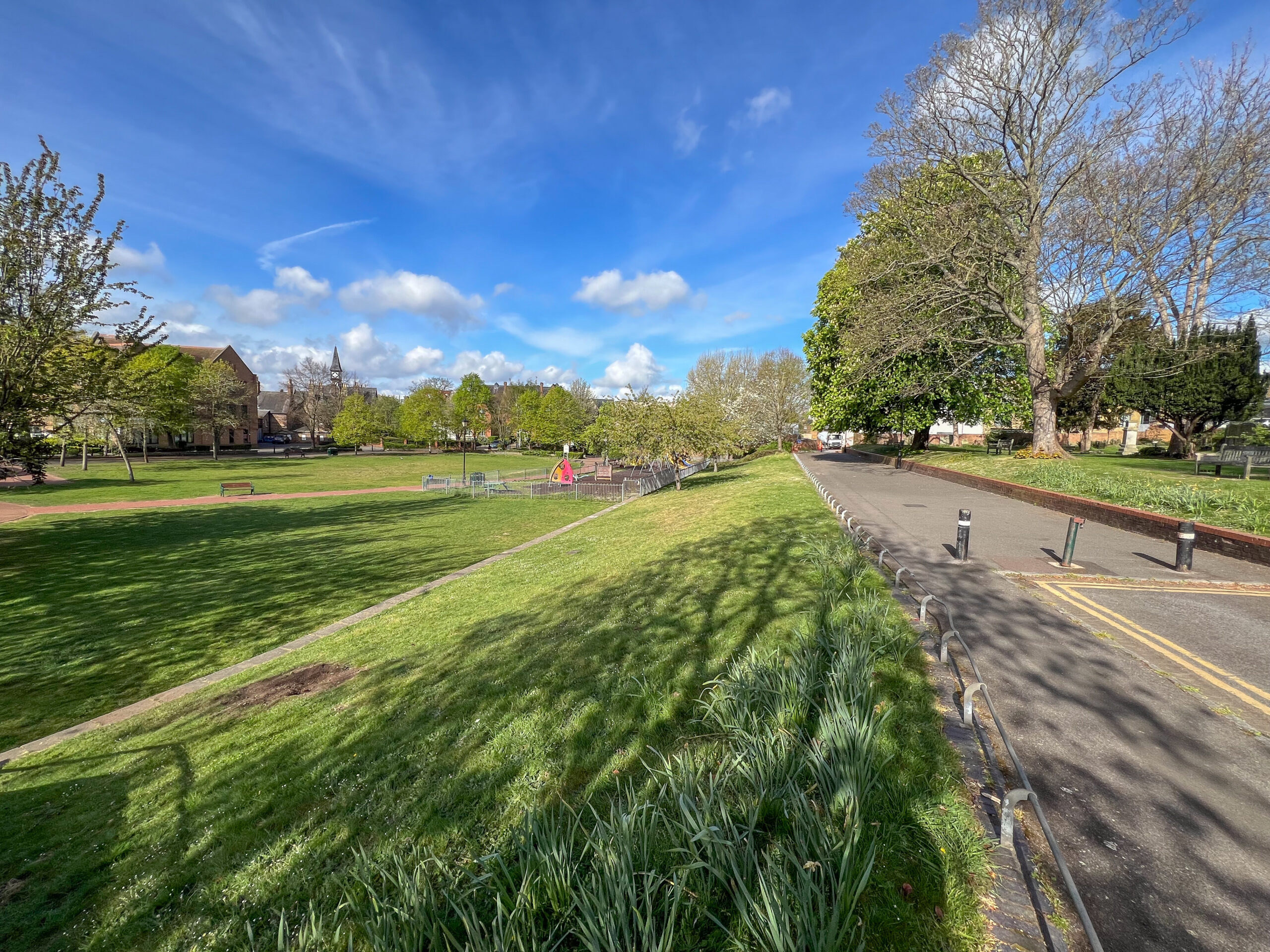
New Windsor had an open field system by which inhabitants owned individual strips scattered in large open fields. The three main fields, for the growth of oats or wheat were “Worth, High and Spelters” these are marked on Dr Astill’s diagram. Worth Field is the area in which Bachelors Acre is located today.
An early reference to Worth Field was made in 1575. “Another endowment enabled the Franklyn Almshouses to be built in Moor Street (now Park Street). A pest house was built in Sheet Street for plague victims. Until that time they had been forced to live in ‘hutches’ in Worth Field”
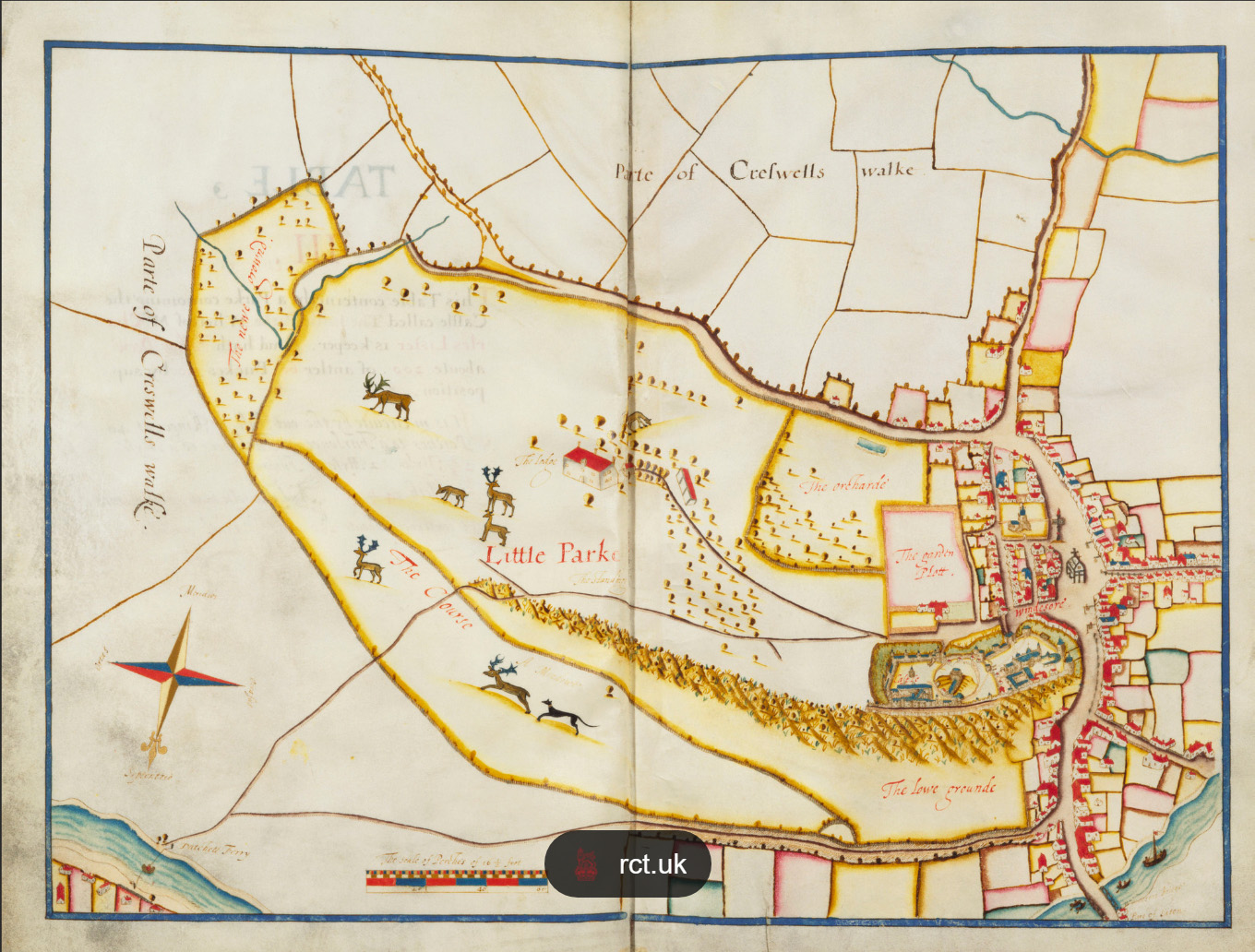
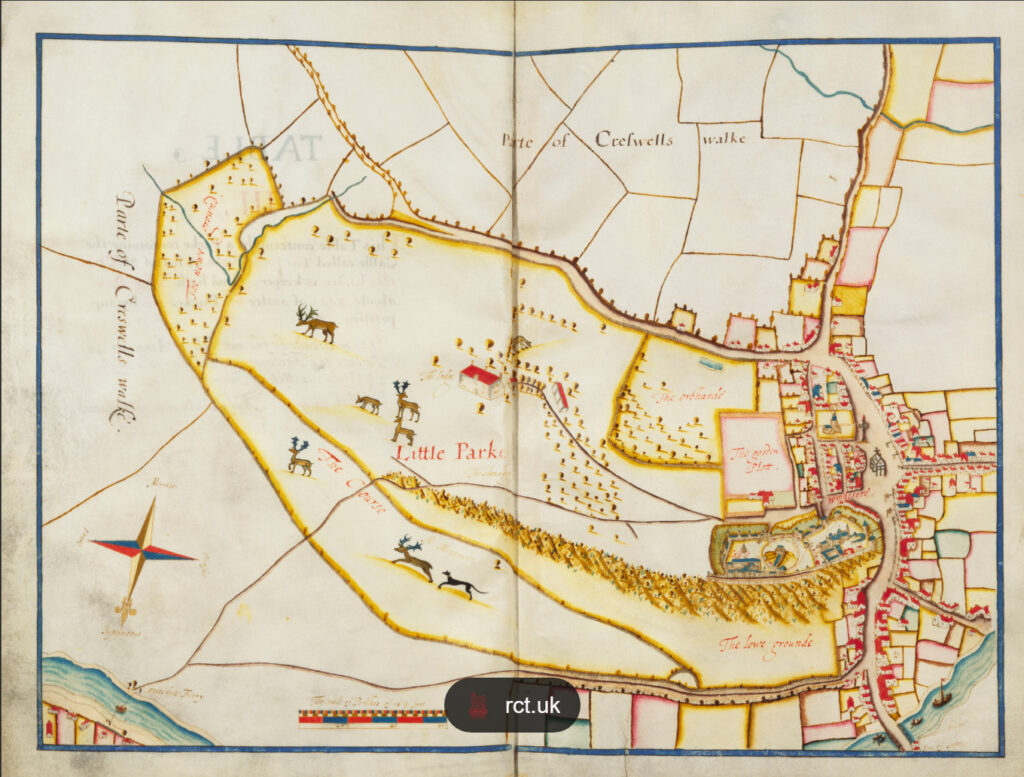
In 1607 John Norden, a cartographer, made for James I a survey of “The Honour of Windsor” which included a bird’s-eye view of the town. Norden clearly marks 7 enclosures around the Worth Field.
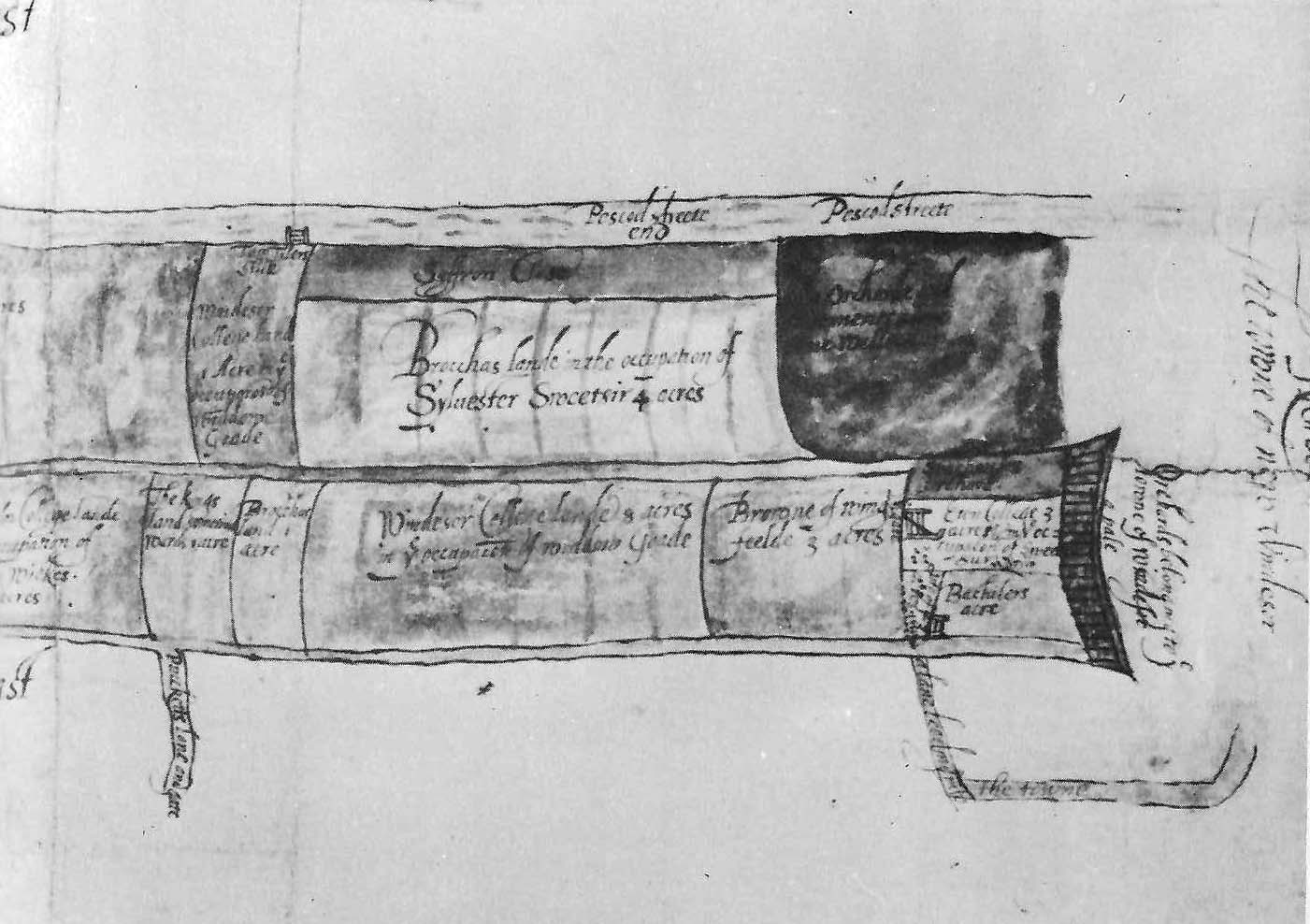
“The Highe Way from Spittle to Windesor” A plan dated 1615 located in The Archives of St Georges Chapel, shows Bachelors Acre and is the earliest known reference.
Sometime in the sixteenth or seventeenth century excavations for gravel were made in the eastern part of “The Worth”, and gave rise to the name “The Pit” or “Pitts Field”
Lease of 1629. Lease of messuage, stable and land in New Windsor to John Fyshbourne. Messuage (a dwelling house together with its outbuildings) with a stable with all the ground thereunto belonging in New Windsor with 3 acres of arable land in a field in the parish of New Windsor called the Werthe, one head butting on the garden of John Fishbourne and a tenement of the Dean and Canons on the north, and the other head on the lands of John Brown on the south, the other two sides adjoining to the pits there called Bachelors Acre on the south and east parts and the other upon the orchard sometime of Roger Starkhouse now of William Reves in the occupation of Henry Browne Bakeron the west part. For 40 years from feast of St Thomas the Apostle last past, at 2s, 1/2 a bushel of wheat, 1 bushel of malt or money in lieu according to the market place, and one couple of capons or 4s in lieu. Signature and tag for seal.
In 1651 Alms houses established at Pitt’s Field (now known as Bachelors’ Acre)”
The name “Pitts Field” was used in an indenture of 1687, relating to four new almshouses built and presented to Windsor by Richard Reeve, father of Sir Thomas Reeve, who married Richard Topham’s sister, Arabella. This family owned much property around the Acre, including a fine house at 1 and 2 High Street.
Reeve had already made several gifts of land, “in consideration that he was born in the Castle of Windsor, and out of the love he bore to the town and borough”. The ground where the almshouses stood adjoined a little lane called the Mangtellis, which ran to the Acre between two of Reeve’s houses, the Uni¬corn and the Chequers, and the orchard of the Chequers overlooked it. The little brick almshouses fulfilled their purpose until the latter part of the nineteenth century, when the foundation was amalgamated with the earliest of all Windsor charities, that which in 1501 had provided dwellings in Sheet Street for eight poor people. The familiar group of forty little houses standing on three sides of a lawn, with a clock-tower rising above them, was then built in Victoria Street. These alms houses are administered by the Windsor Municipal Charities Trustees.
The constitution of the Bachelors of Windsor is difficult to define. There is proof positive that in mediaeval times it was the meadow where young men practised with their bows and arrows. A pair of butts was set up there. They shot at the targets. The word “bachelor” was in those days used to describe “A young knight who followed the banner of another, a novice in arms.” That is the first meaning in the Shorter Oxford English Dictionary, 3rd ed. (1944), p. 134. Later on, when the long bow went out of use, the young men practised with their muskets.
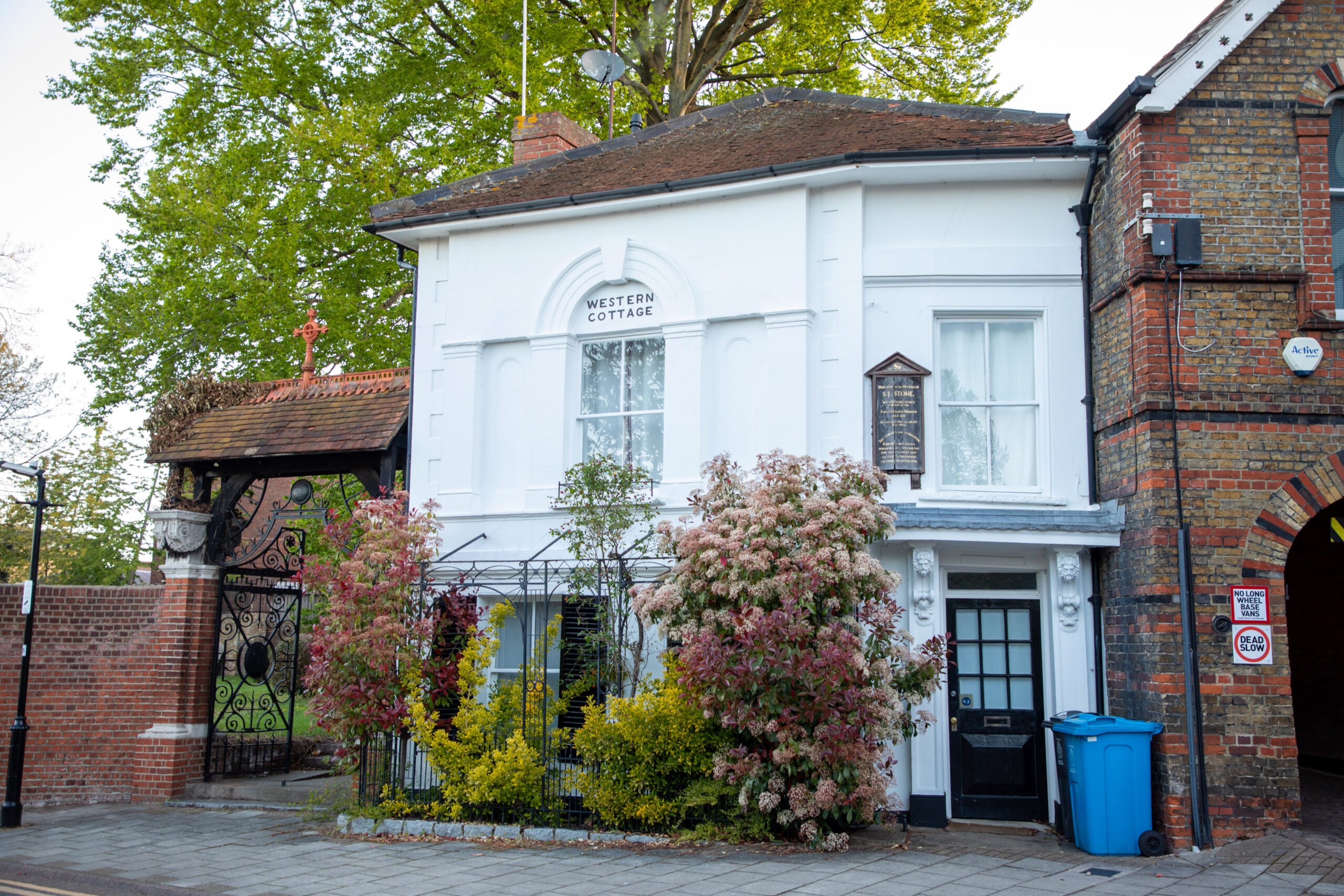
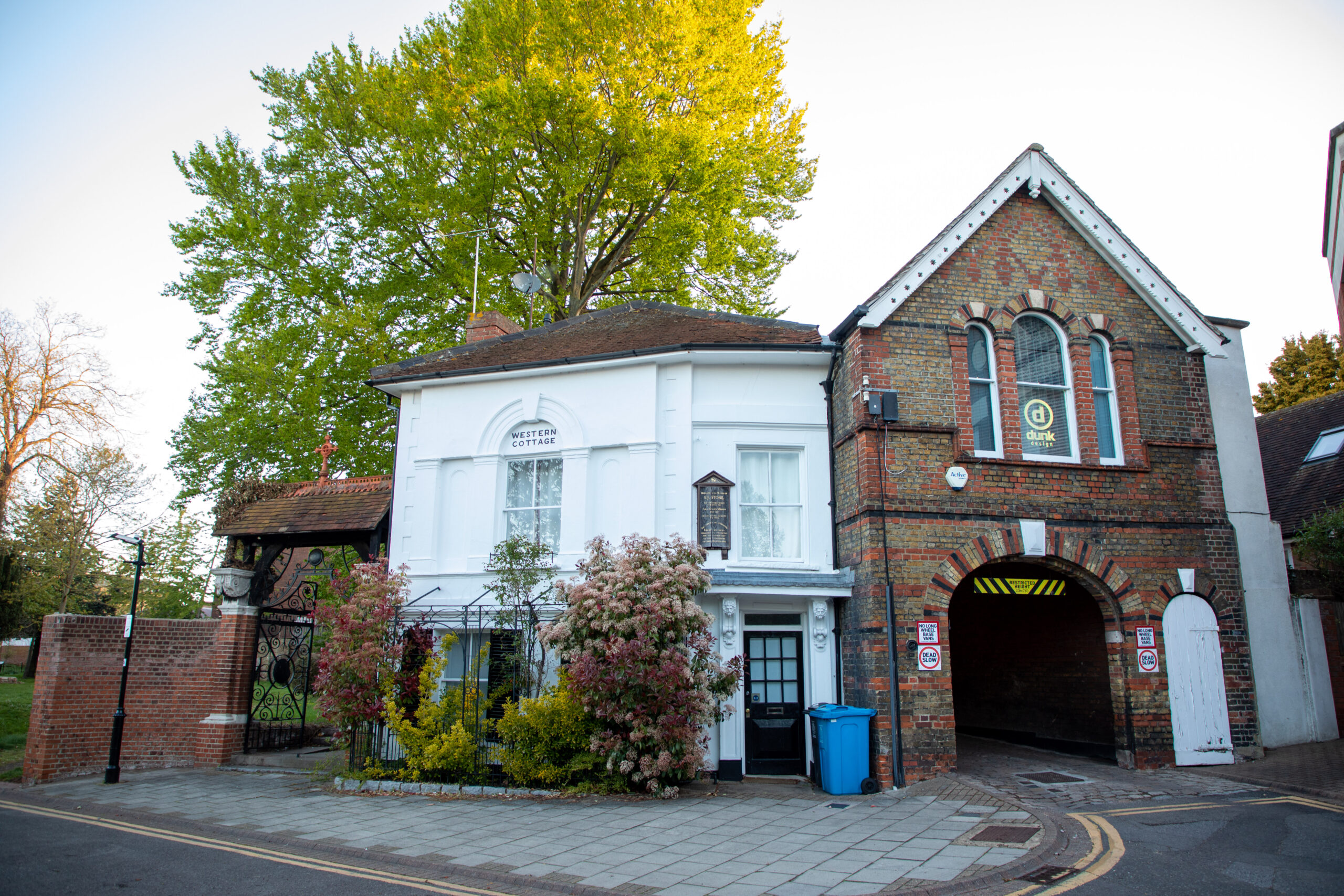
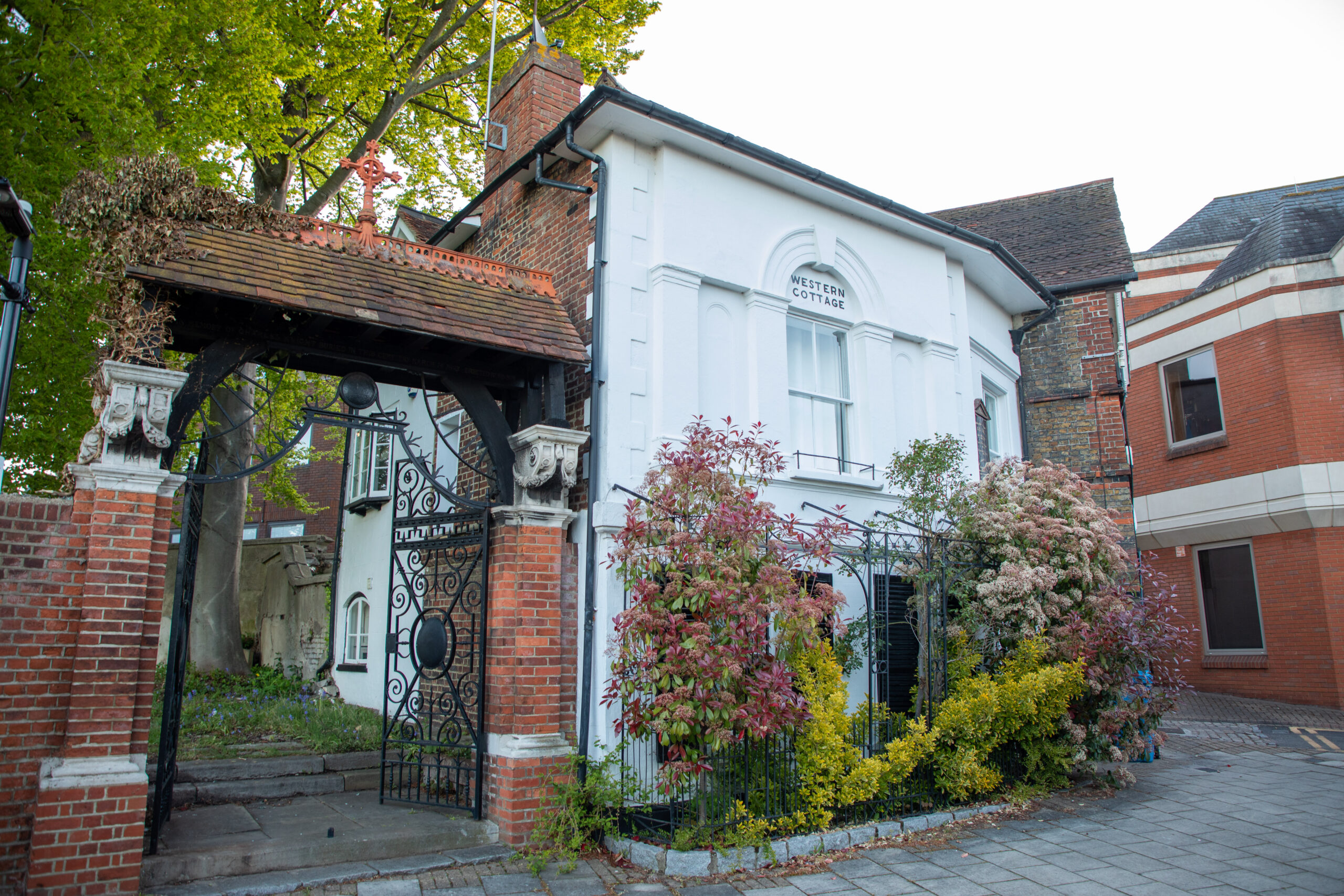
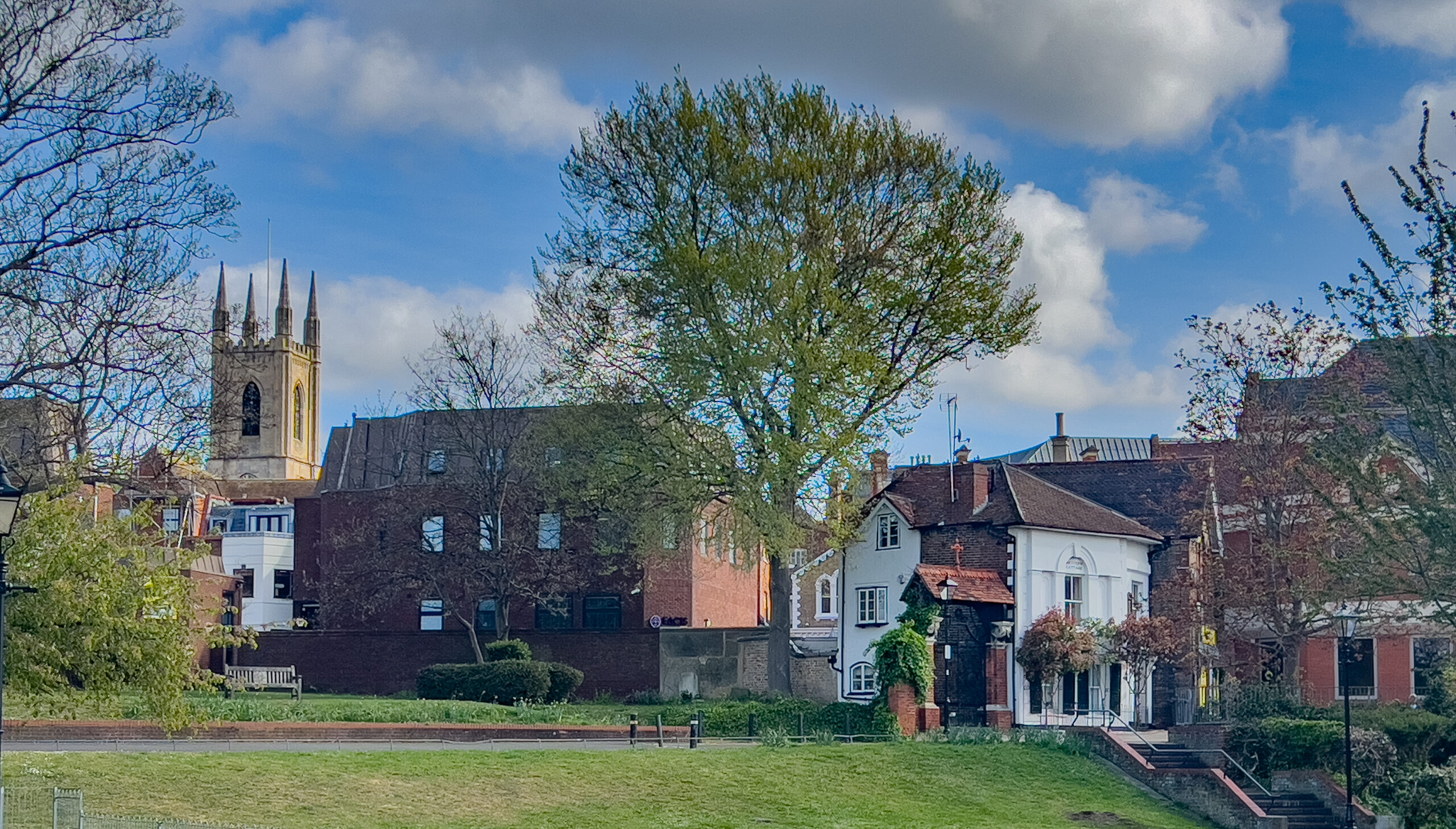
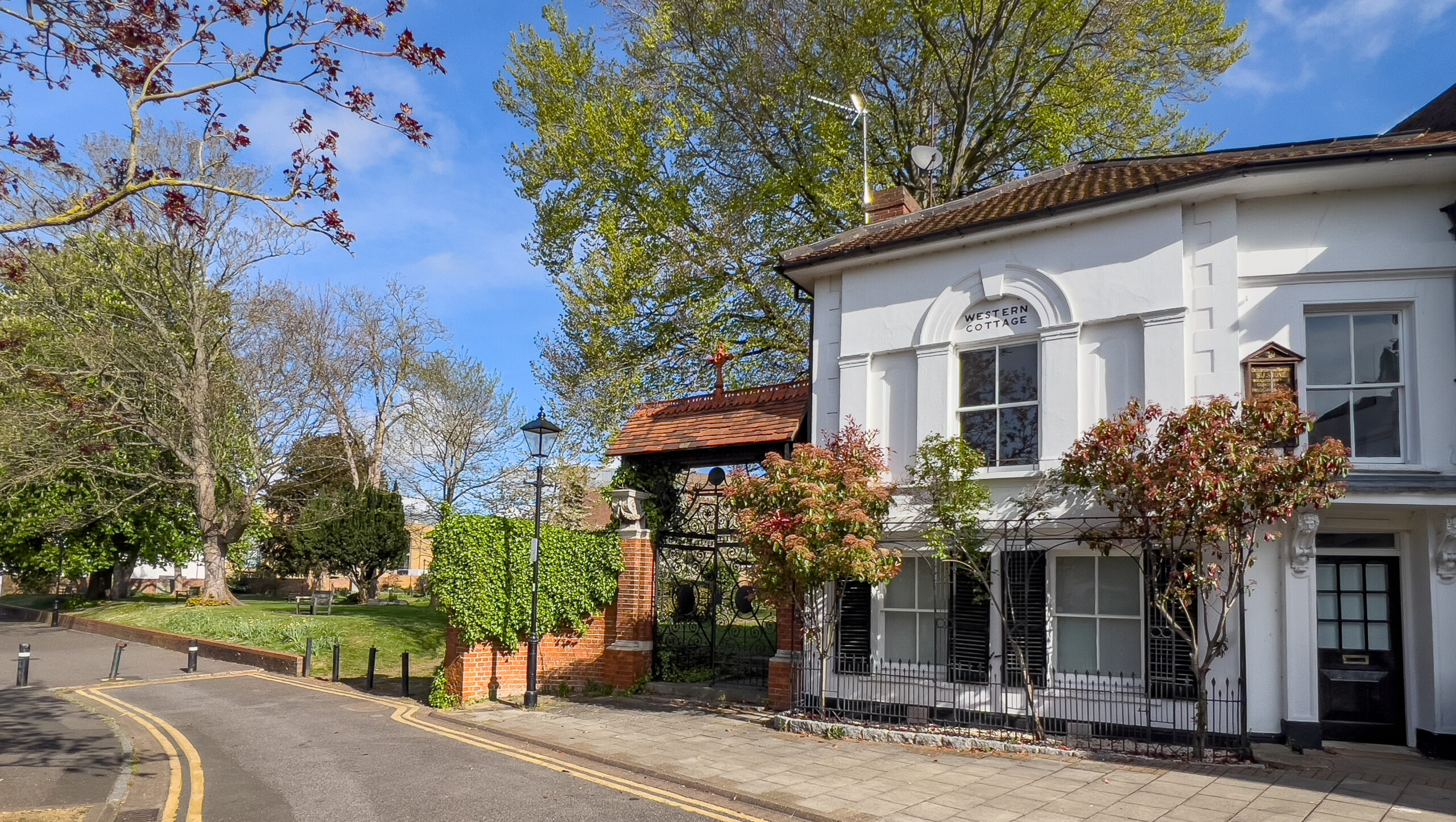
In 1702 Western Cottage, overlooking Bachelors Acre was built for Queen Anne’s secretary.
A later lease of 1704 shows that by that time the butts had disappeared: but nevertheless the corporation stipulated that “all . . . persons” should have access to the ground “to use and exercise any lawful pastime for their recreation at all convenient times.”
The term Bachelors’ Acre appears to have come into use during the early years of the eighteenth century, for it is found on Collier’s map of Windsor dated 1742.
In 1749, there was a new lease to William Tyrrell of the Inner Temple, which contains the same stipulations. The words “the people” and “all . . . persons” in those deeds clearly meant the inhabitants of New Windsor.
1756-1763 Counterpart leases of stable and ground in Le Worth to William Foster of New Windsor, brewer. Stable with ground late belonging to a messuage heretofore there standing with 3 acres of land in a field called Le Worth, formerly arable, now part of which is an orchard and abuts north on a passage or walk leading from the dwelling house late of Richard Fishburn in part, a garden of a tenement of the Dean and Chapter in possession of Mr Randall in part and the garden of an inn formerly called the Unicorn, upon the Pitchfield towrads the south, the west side of the same upon the orchard in the occupation of William Caukett, and east upon a pit called Batchelors Acre in part and a piece of land formerly belonging to Mr Topham, between which and Batchelors acre is half an acre, part of the said 3 acres.
A corporation lease of 1761 granted to Christopher Lofft “All that piece or parcel of ground called or known by the name of Bachelors Acre lying and being in the parish of New Windsor where Butts formerly stood.” The lease was for forty years, at an annual rent of 3/4d, with the proviso that it must remain open for ‘any lawful recreation at all convenient times’
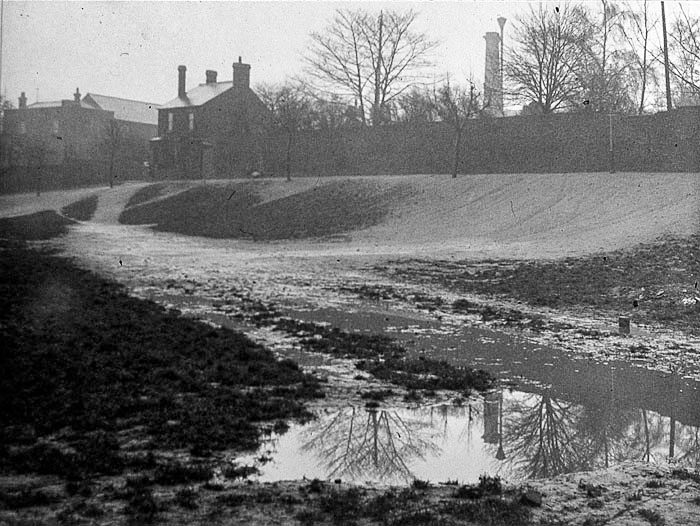
Such was the position down to the year 1789. But then it seems that Bachelors’ Acre was much neglected. The occupiers of houses made drains into it, which flooded it, all and sundry threw dung and rubbish on to it.
In 1795 the construction of the infantry barracks opposite began (completed 1803) The site was an acre of land in Sheet Street next to the workhouse.
Bachelors Acre became such an eyesore that in 1809 a group of the inhabitants banded together to improve it. They called themselves the Bachelors of Windsor. This did not mean that they were all unmarried men. It was only a name to denote a group of public spirited inhabitants, married and single. young and old, determined to assert their rights. They removed every encroachment. They filled up a large pond. They raised the ground and levelled it. They turfed it afresh. Many lent their horses and waggons to fetch turf from different places. When they had finished their work on October 25th 1809 they had a great celebration there to mark the jubilee of King George III.
25th of October 1809. King George III Jubilee. “It was a celebration throughout the land, but none his subjects felt more closely aligned to him in loyalty and affection than the Bachelors of Windsor. They too, were celebrating their jubilee. The Society had been founded in 1760 to safeguard public rights on Pitts Field, or Bachelors Acre as it had been come to be called. Because butts for the practise of archery was set up in King Edwards III reign, a tradition persisted that he had given it to young men of Windsor for their recreation. The bachelors were all the men of standing in the town and to celebrate their Kings Jubilee they organised a great festival on the acre. An ox and two sheep were roasted whole and a gigantic plum pudding boiled.
The King being blind did not go down to the Acre, but Queen Charlotte went with the Duke of York, Clarence, Kent and Cumberland and the Princess Augusta, Elizabeth and Sophia. The roasting had begun at midnight. And the ox was ready for carving by the time the royal party appeared at one o’clock in the afternoon. They were welcomed by 50 bachelors (Including George Knight) in their evening dress of blue coats, white waistcoat, white breaches and silk stockings. The Bachelors were careful to note the recipe in their Committee Book, 1809-17, a copy of which is extant, and which is prefaced by their motto: “The Bachelors of Windsor will revere their King, and preserve their Right”. From it we learn also the names of the committee appointed to arrange the celebrations and receive Her Majesty; they included one very celebrated Windsor personality, Mr. Charles Knight, Senior, who printed the Committee Book. The first slices of beef mutton and plum pudding were handed on silver plates to the royal guests, who all tasted and appear highly pleased with the novelty. All that day, Windsor was filled with the sound of trumpets. Bells and drums, the cavalry paraded, there were feasts and fireworks and illuminations, and the rejoicings ended with the water pageant at Frogmore”.
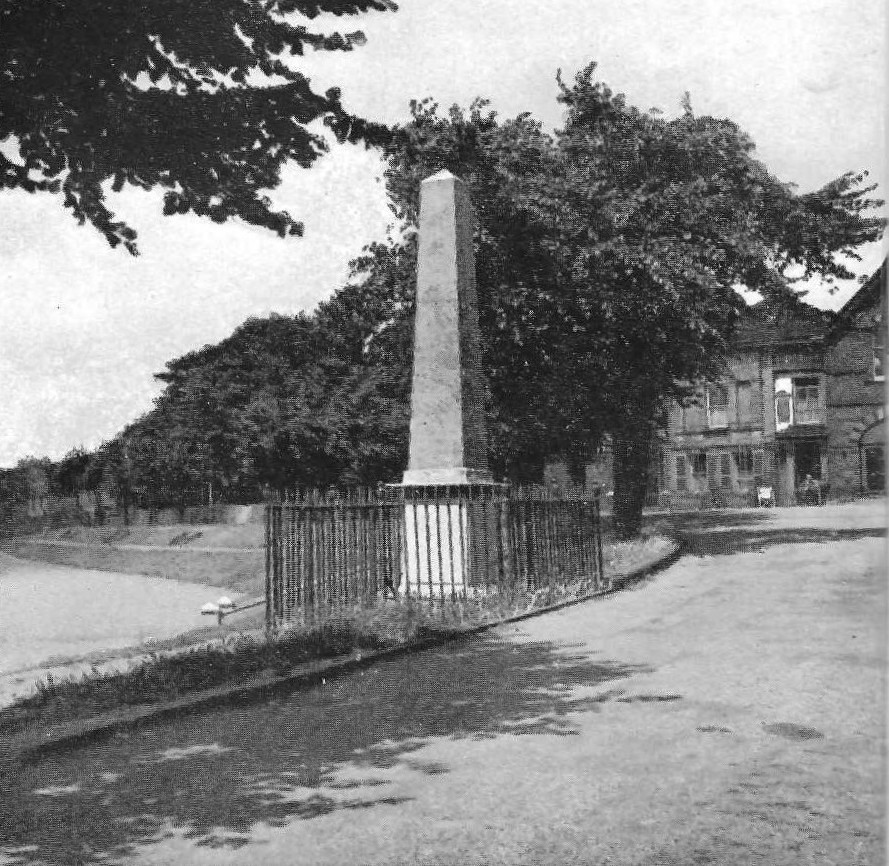
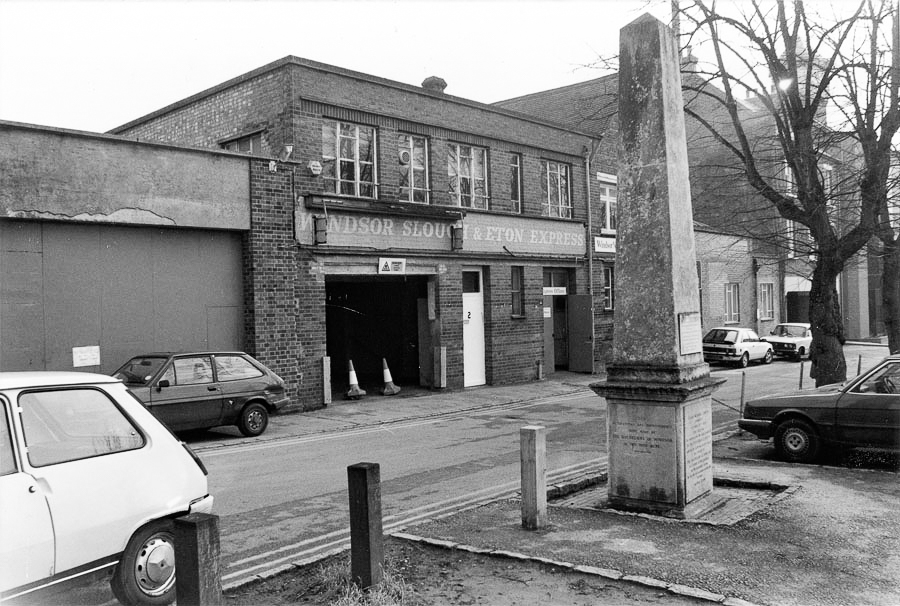
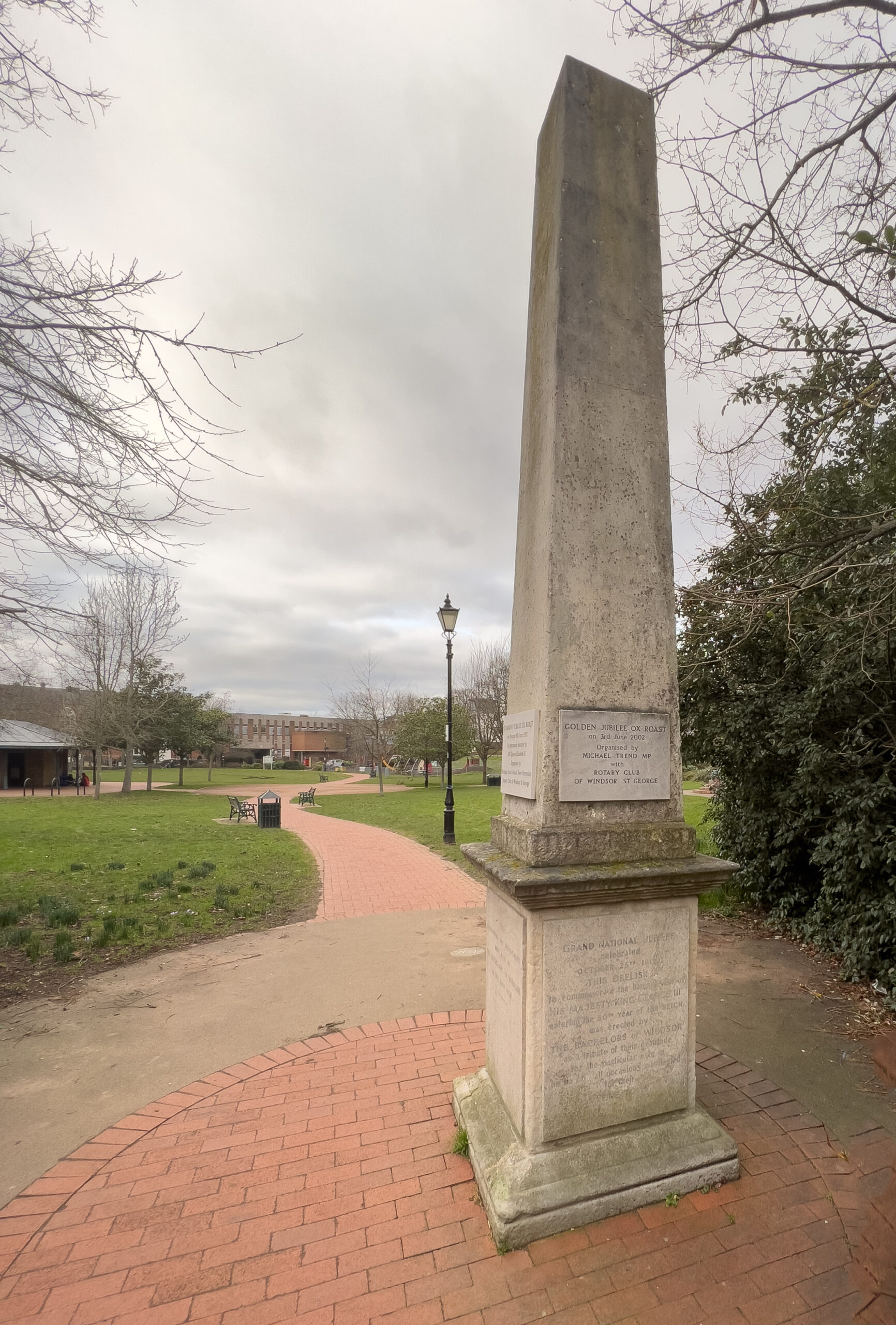
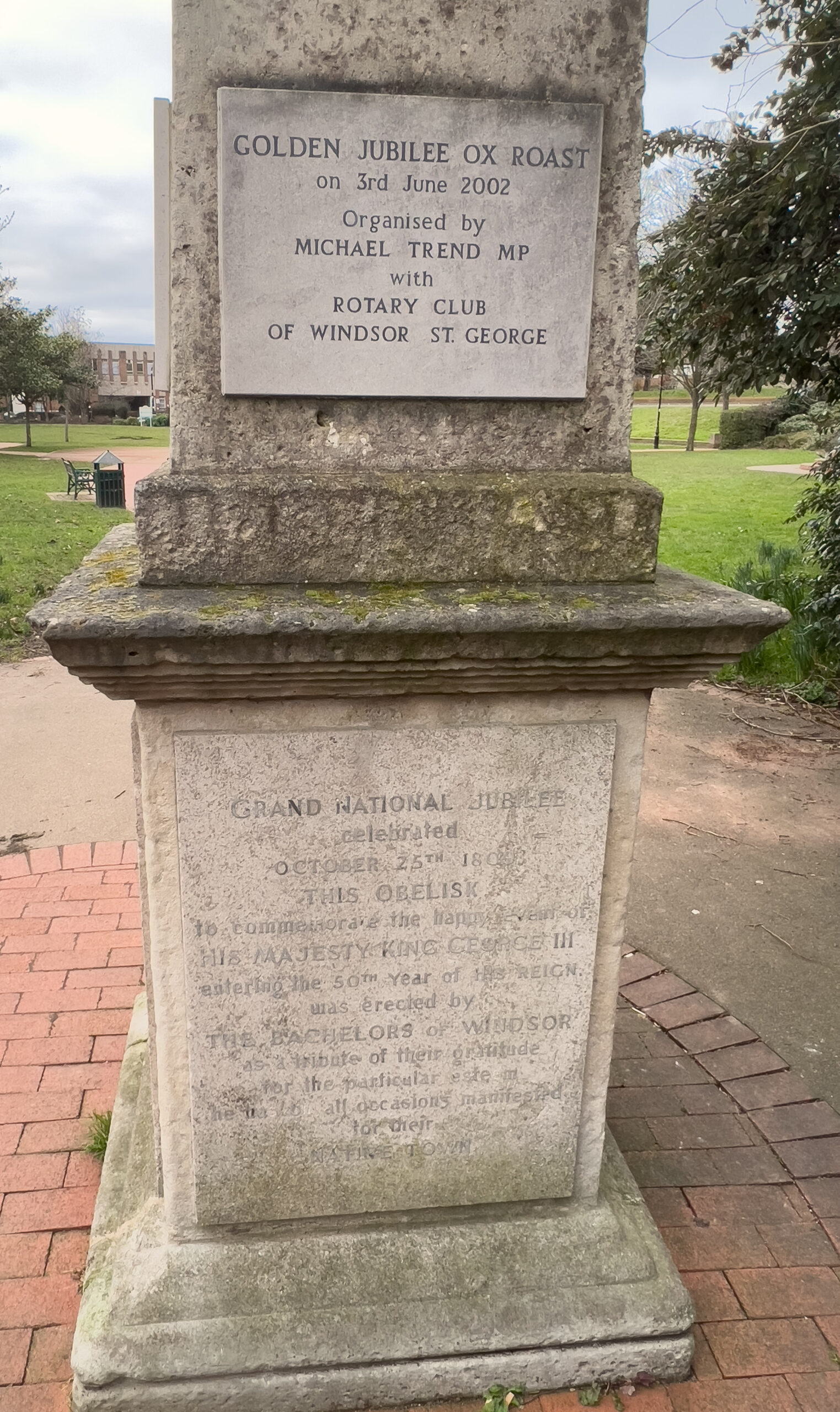
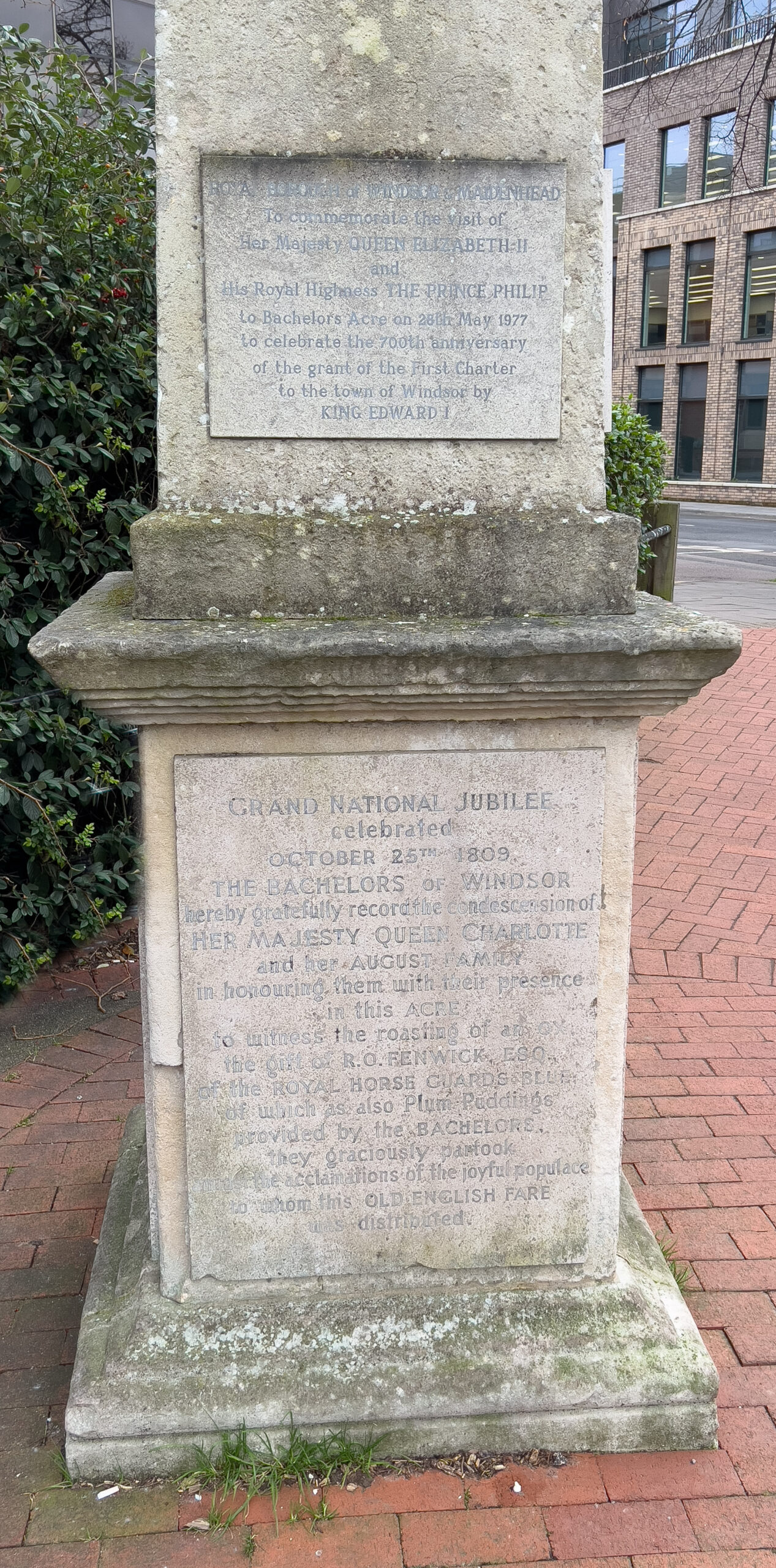
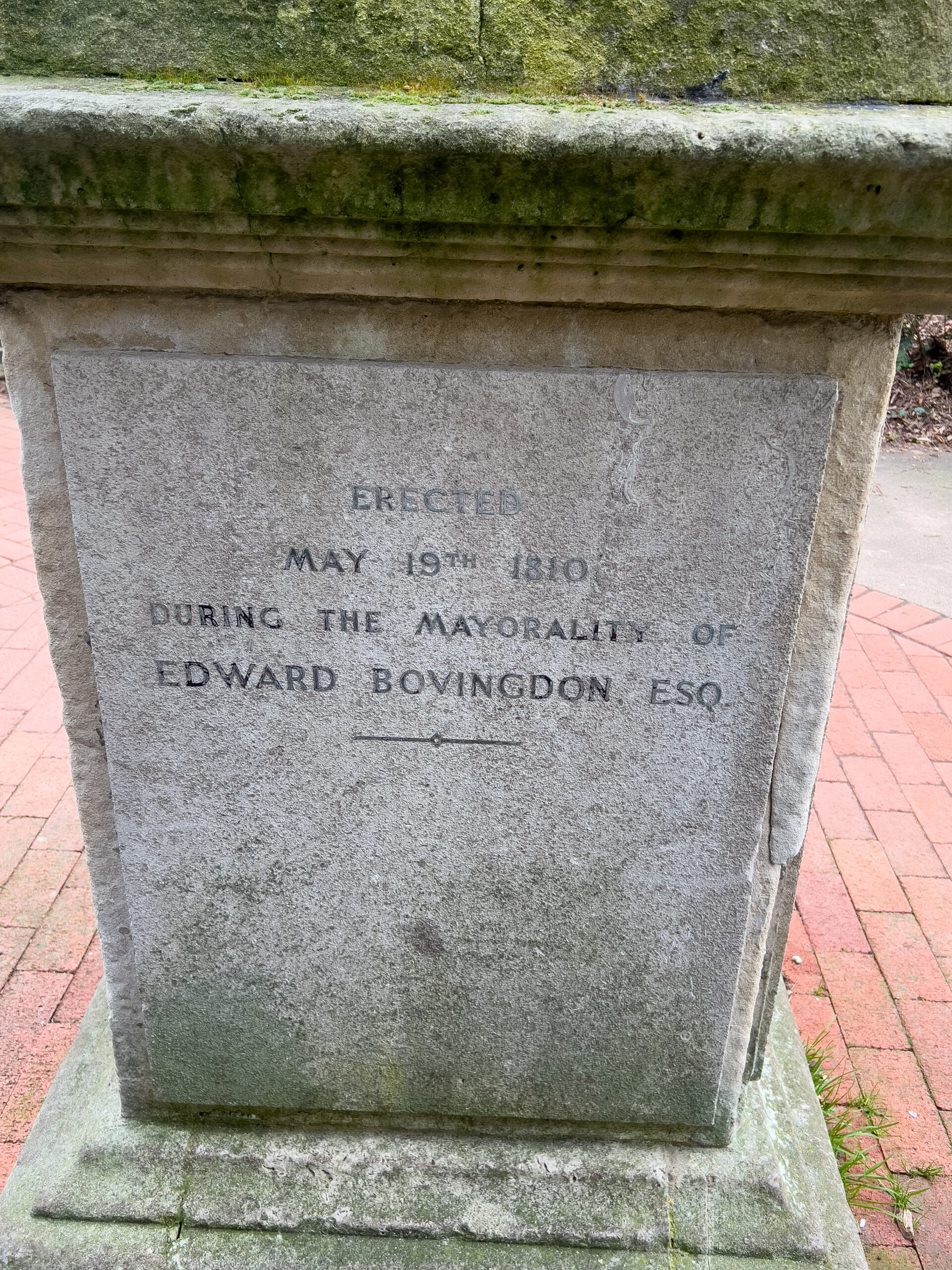
On 19th May 1810 the Bachelors erected a Portland stone obelisk 17 feet high, which although moved is still at the Acre today, some of the original inscription has since worn away.
Two inscriptions record the purpose of the monument. First the tribute of the bachelors, expressing their gratitude for “the particular esteem” that the king had on all occasions manifested for their native town. Second to record the condescension of Queen Charlotte and her August family in honouring the Bachelors with their presence in the acre to witness the ox roasting. “The gift of R. O. Fenwick, Esquire or the Royal Horse Guards blue, of which, as also Plum Puddings, they generously partook amidst acclamations of joyful people to whom this Old English Fair was distributed. Much of the original inscription on the obelisk wore away many years ago.
On the side there are the words:
GRAND NATIONAL JUBILEE celebrated
OCTOBER 25, 1809
The Bachelors of Windsor
hereby gratefully record the condescension of HER MAJESTY QUEEN CHARLOTTE and Her August Family
in honouring them with their Presence
in this Acre
to witness the Roasting of an Ox the Gift of R. 0. Fenwick, Esq. of the Royal Horse Guards Blue
of which, as also “Plum Puddings” provided by the Bachelors
they graciously partook
amidst the acclamations of the Joyful Populace To whom this Old English Fare
was distributed
This Obelisk
to commemorate the hapoy event of His Majesty King George III entering the 50th year of his reign was erected by
The Bachelors of Windsor as a tribute of their Gratitude for the particular esteem
He has on all occasions manifested for their
Native Town
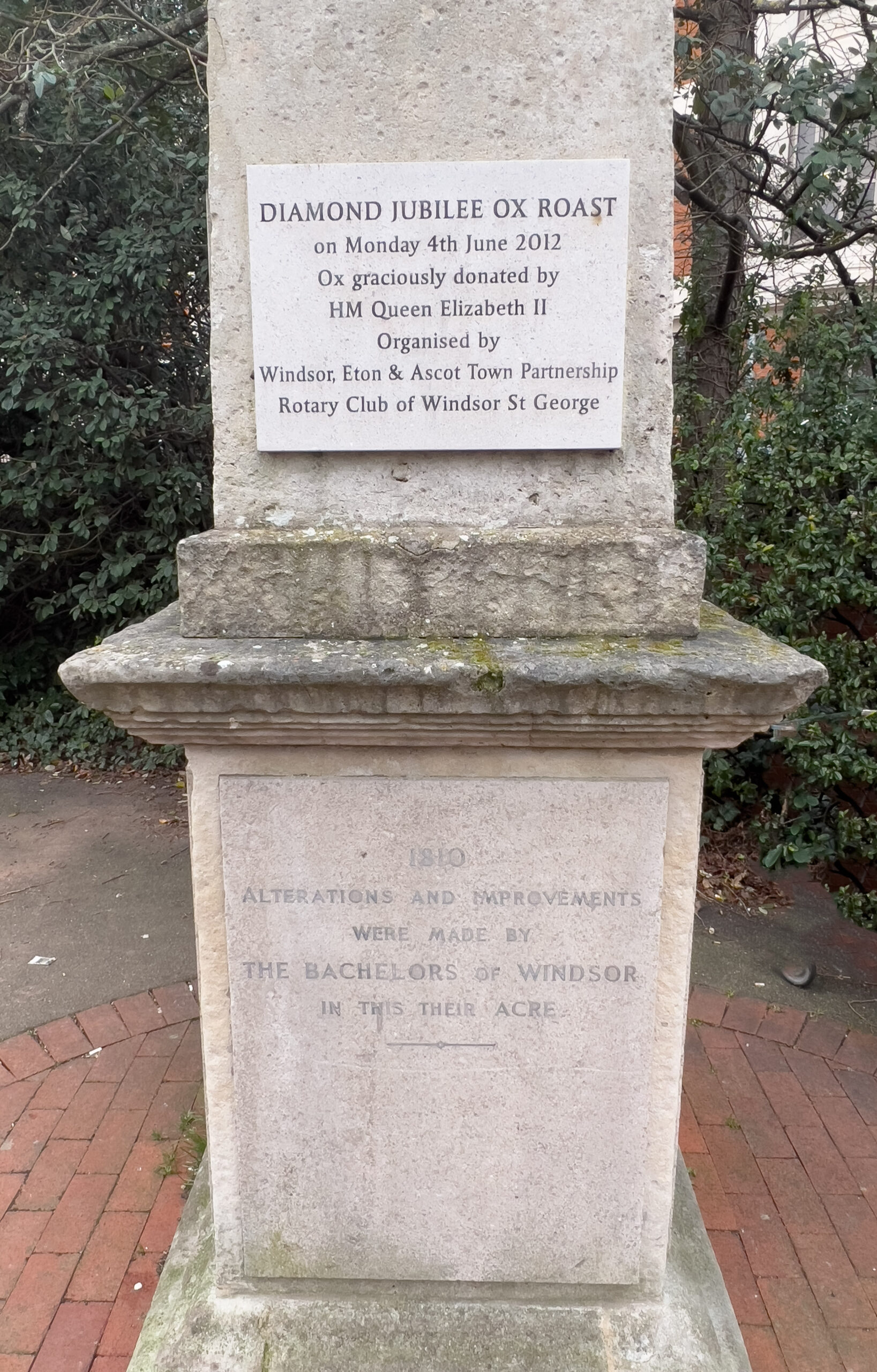
“1810
Alterations and Improvements
were made by
The Bachelors of Windsor
in this their Acre”
In the summer of 1810 a grand match of cricket was played on the acre across which a few months before it was impossible to walk.
In 1814 the “Natives and Bachelors” successfully opposed a proposed enclosure, and at a celebration at the Swan Inn in 1817 the chairman expressed the hope that the obelisk would remain “the bulwark of the rights of the Bachelors of Windsor even when the all-powerful hand of time shall have crumbled more magnificent structures into dust.”
A little brown handbill says:
The little brown handbill is worth quoting for its own quaint sake.
It says:
Bachelors’ Jubilee.
On SATURDAY, MAY 19th, 1810, Being HER MAJESTY’s BIRTH-DAY.
PRIZES
Will be given for the following Amusements in the Bachelors’ Acre.
Maids to run for a Gown, no less than three to start, (the best of3 heats). Jumping in Sacks for a Smock Frock.
Bachelors to eat Rolls and Treacle for a good Hat. Grinning through Horse Collars for a fine Irish Shirt. A Jingling Match for a Crown.
Wheeling a Barrow, blindfolded, for a valuable Silk Handkerchief. Boys to dip for Oranges for a Plum Cake.
Proper Directors will be appointed.
According to legend, there was an adjacent Maidens’ Acre towards the bottom of Peascod Street. I understand The Royal Free School and the Infirmary were built on this land.
1817 Claims to the Acre under the New Windsor Inclosure Act were made by the Corporation, Eton College and the Hon. Mr. Keppel. The land was adjudged to the Corporation in 1817 for their “full manorial rights”, and the overjoyed Bachelors, who had been agitating for recognition of their own claim and appear to have misunderstood the award, presented their Chairman, Edward Bovingdon, jun., with a silver cup. The ceremony took place at the Swan Inn, their usual rendezvous, after the Windsor and Eton Junior Cricket Club had concluded the season with a match on the Acre, which Edward Bovingdon called the only place where the bachelors can now legally assemble for recreation”.
In 1818 a committee was appointed to consider the rebuilding of the Parish Church, there was also the need to extend the burial ground, so a piece of land was bought, behind the houses opposite, and adjoining the Bachelors’ Acre, part of the garden of Mr. John Hatch.
In 1819, when the land was leased to a local butcher, called William Perryman, the rent had increased to £9 a year. The measurements of the Acre were defined as two acres, one rood, thirty-two perches (it had shrunk since 1814, when it extended to two roods, twelve perches).This lease specifically mentioned “the right, freedom and privileges of the native Bachelors of Windsor of exercising all lawful sports and pastimes upon the said pasture ground at all times during the term.” The lessee was not to convert the Acre into garden or tillage, and he had to keep certain gates, stiles and fences in repair.
Annual Revel 1817 – 1855“Maids to run for a Gown, Jump in Sacks for a small frock, Bachelors to eat rolls and Treacle for a good hat, Grinning through horse collars for a fine Irish shirt, etc. A jingling match for a crown. Wheeling the Barrow blindfold for a valuable silk handkerchief. Boys to dip for an orange, for a plum cake, and so on.
The New Road (Victoria Street and Clarence Road) was created in 1820 allowing for new house building. Materials from the destruction of Queen’s Lodge were used.
Mr Knights guide had no doubts about the status of the Bachelors’ Acre. “It had long been appropriated by prescriptive right, and more recently by the award of the Commissioner of Forest Enclosure, to the use of the commonalty of Windsor for their amusements”.
In 1830 the Annual Revel events included: An under 15 cricket match followed by boys climbing soaped poles for boys winding a string for yards. Long round peg. Six men blindfolded, whipping a ball out of a hole. Will Carters whip? Six men running after a pig. With the soaped tail, men jumping in sacks, a giggling match, a donkey race. Back swording and wrestling. Men grinning through horse colours. Men smoking 3 pipes tobacco and drinking 3 pints of beer each. Boys eating rolls and treacle. And for us this firework display to follow.
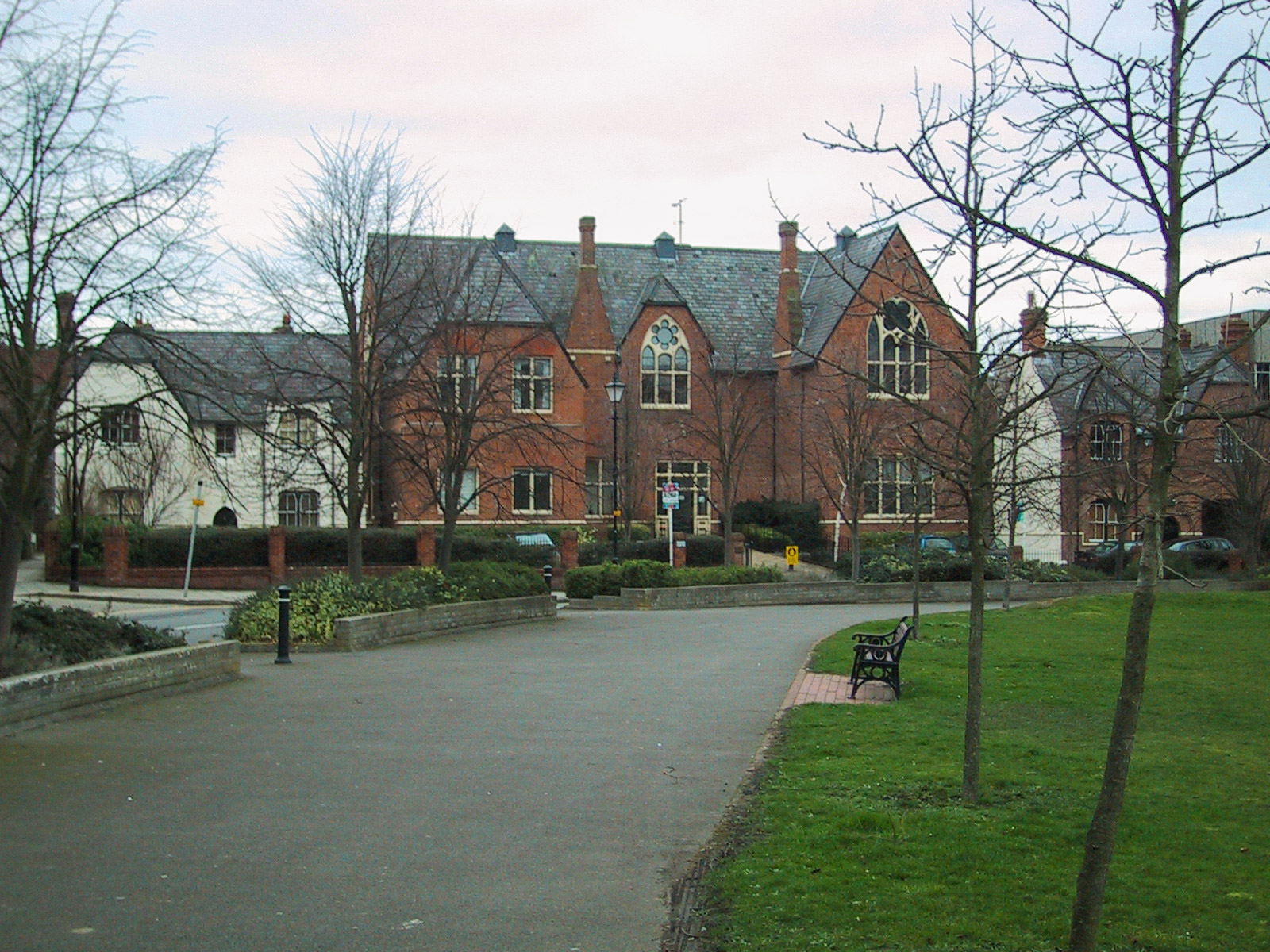
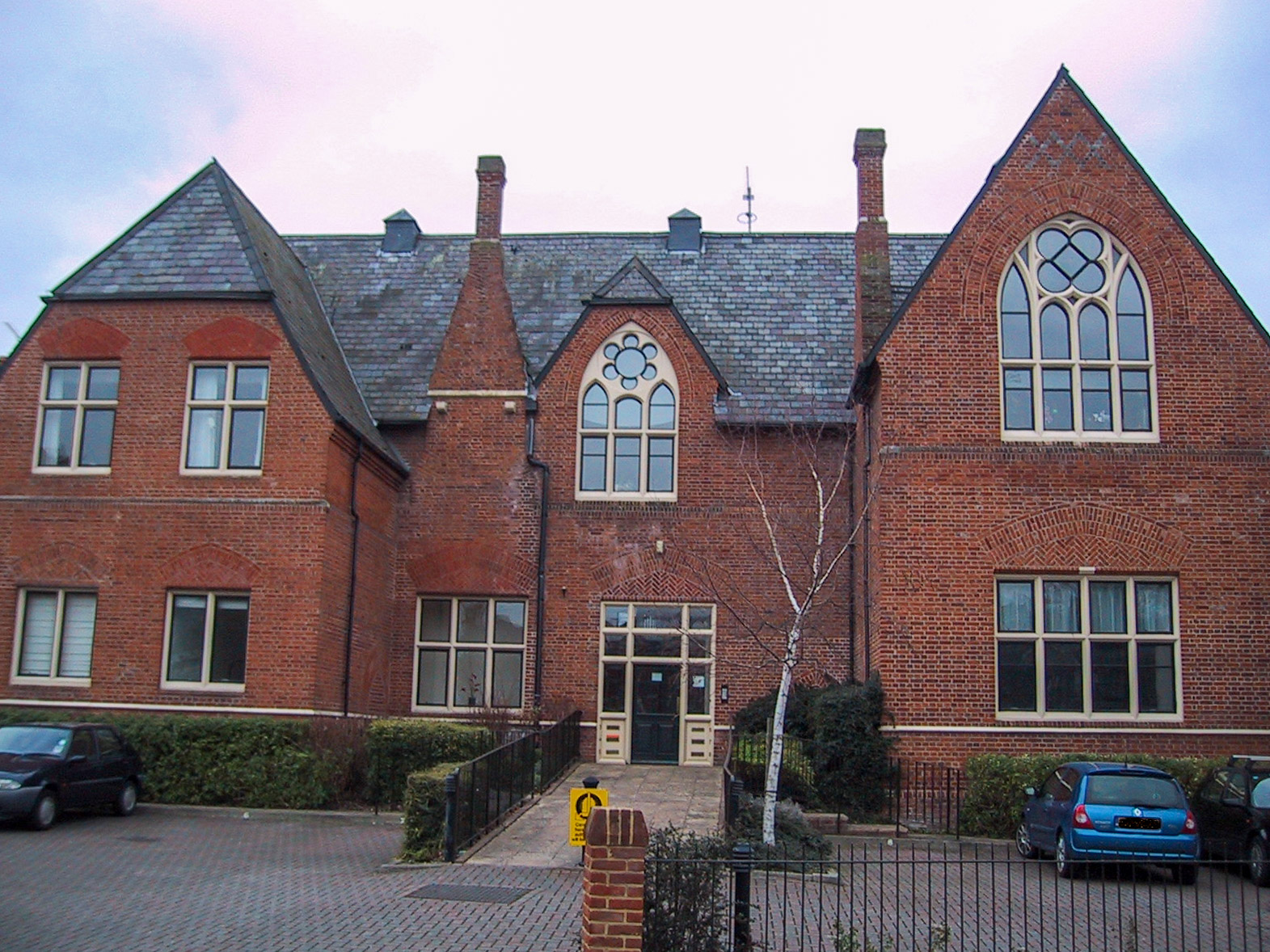
In 1832 the Dispensary received a legacy of £500 from the estate of Mary, Countess Harcourt and at its Annual General Meeting in January 1833 a Building Committee was formed, A piece of land which lay at the apex of a triangle formed by New Road (now Victoria Street) and Bachelors’ Acre was bought for £150. The Windsor Savings Bank bought the adjoining site, and a uniform design for the two buildings was agreed. Mr Bedborough’s tender was accepted and the work completed in July 1844.
1833, A subscription was raised in the town to cover the cost of removing a long existing nuisance, the Black ditch in Bachelors Acre by making a new drain.
1836 The stupendous skeleton of a whale, 102 feet long was exhibited near the dispensary on Bachelor’s Acre and drew large crowds willing to pay the rather curious scale of charges laid down. Gentry 1 Shilling. Tradesmen, operatives and children’s sixpence.
17th August 1841 The annual revel on Bachelors’ Acre was described in The Times
In May 1842 great crowds were entertained in the Acre by the feats of Signor Duvalla who ascended four hundred feet ‘on an inclined plane by rope’. A balloon ascent proved impossible, as the balloon caught fire whilst being blown up.
The Bachelors Annual Revel took place as usual on 17th August, beginning at seven in the morning with a royal salute in the Acre. The churches pealed their ‘merry chimes’ and the Bachelors went in procession through the town. The stalls, booths and sideshows were very numerous, and a great many people came by rail to witness.
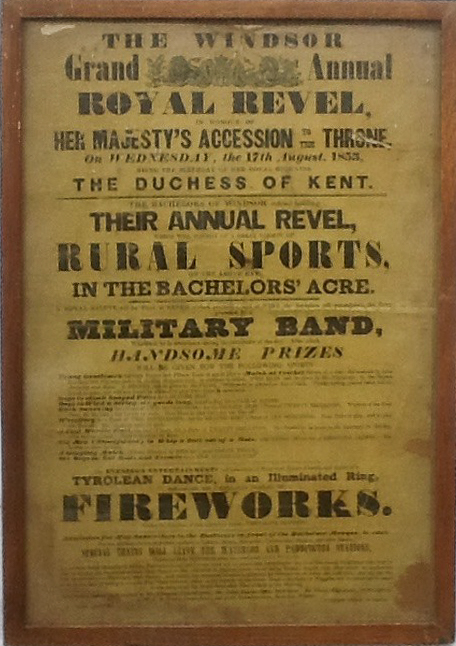
Rural sports, alas, falling into disuse throughout the country, but which were kept up in Windsor with all their former vigour’. An advertisement for the Revel listed the events for which there were prizes — a boys’ cricket match, climbing soaped poles, backswording, wrestling, a hurdle race, six men. blindfolded, to whip a ball out of a hole, with carter’ whips, and a gingling match (fifteen minutes) by men, for which the prize was a good smock frock. ‘Gingling’ was an old spelling for ‘Jingling’, so one can only suppose that the contestants had a quarter of an hour to make up a rhyme on a given topic.
The Acre was full of stalls, booths and sideshows. In earlier times bullbaiting would have been one of the principal attractions. but this barbarous sport had been made illegal by Act of Parliament in 1835. The day ended with the usual firework display.
As well as the regular October fair revels were held to celebrate Royal birthdays the largest ever being that for King William IV’s birthday on 22nd August 1836.
A Royal Salute at 9am. followed by a perambulation of the Acre by the Bachelors with a military band, and numerous events and competitions for men and boys were held throughout the day. (Full details are recorded in the Windsor and Eton Express, but included climbing a soaped pole for a beaver hat, and a wrestling match for a purse of 10 shillings.)
In 1847, there was the “Battle of Bachelors’ Acre.” The local authorities sent four men to dig a well in Bachelors’ Acre so as to supply water to the streets. Several hundred people thought that this was an invasion of their rights. They came with spades and shovels to fill up the well. The police went to stop them, but they threw volleys of clay and turf at the police, who had to withdraw. The people filled up the well and put up a flag over the spot. They celebrated their triumph with a bonfire and fireworks. Later the town council and Mayor Mr. Bedborough passed a resolution that there should be an agreed site for the well “so as not to interfere with the enjoyment of the same by the inhabitants.” but no more seems to have been heard of the matter.
The Bachelors’ Revels took place annually, immense crowds coming by rail to see their archaic sports, but by 1849 subscriptions were falling off, and the railways, which gained so much, contributed nothing. Alderman Blunt had raised in the Council the whole question of the ‘immoral tendencies’ accompanying the Revel, and this had evoked a spirited reply from the Bachelors, supported by a testimonial from most of the residents near the Acre to the effect that any interference would be totally unjustified. This attack on the Revels was nothing new, but the Windsor Fairs had recently been commended for the good behaviour of all concerned: for instance, the Michaelmas Fair in 1849 had been notable for ‘the congratulatory fact that (thanks to the vigilance, daily and nightly, of the police) the offences common to these seasons or rustic saturnalia were unusually few’.
1852 Two new complaints were voiced about the Acre; the disgraceful language used by schoolboys playing there which only firm action by the magistrates could stop.
Then in summer a letter to the paper signed Old Inhabitant criticised the beating of carpets which was carried on there. The sound, he wrote. was like the booming of distant cannon, alarming the horses and making breathing difficult in the flying dust, all this in the immediate vicinity of the infirmary. ‘Talk, talk, talk, talk, there has been times out of number upon the subject of the Acre. It is high time we had a little action’.
17th August, 1853, the birthday of H.R.H. the Duchess of Kent”, the great Variety of Rural Sports included nothing more outrageously hilarious than climbing up soaped poles. Some of the competitions, such as winding string round pegs, might even have been suspected of tameness; and the cricket match for “Young gentlemen between 11 and 15” must have been conducted in an atmosphere of disarming felicity, for all the players, winners and losers alike, were to receive sixpence apiece-with rosettes extra for the winners¬and a grand dinner.
The Bachelors “beat the bounds” of their domain in the morning, and what with the pealing of bells, the firing of a “feu de joie” under the East Terrace of the Castle, the marching and counter-marching, the bands, the Tyrolean dance in an illuminated ring at dusk, and the magnificent display of fireworks, the day would seem to have had a bright jubilance which glows out even now, at the mere recital of its pleasures.
In 1853 an angry resident reported that the Fair in the Acre, had been the occasion for noise and drunkenness, attracting a congregation of tramps, swindlers and pickpockets.
‘Bachelors’ Acre always presents a dirty appearance, but when plenteously watered by torrents of rain, as it usually is at Fair Time, I can scarcely imagine a more disagreeable spot’.
Annual festivities were held on the acre until 1855. By 1855, growing local opposition meant that the Revels eventually stopped . The power of the Bachelors waned from that time, and the organization lapsed long before the end of Queen Victoria’s reign, though certain gentlemen continued to uphold the old rights very jealously even during the first quarter of this century
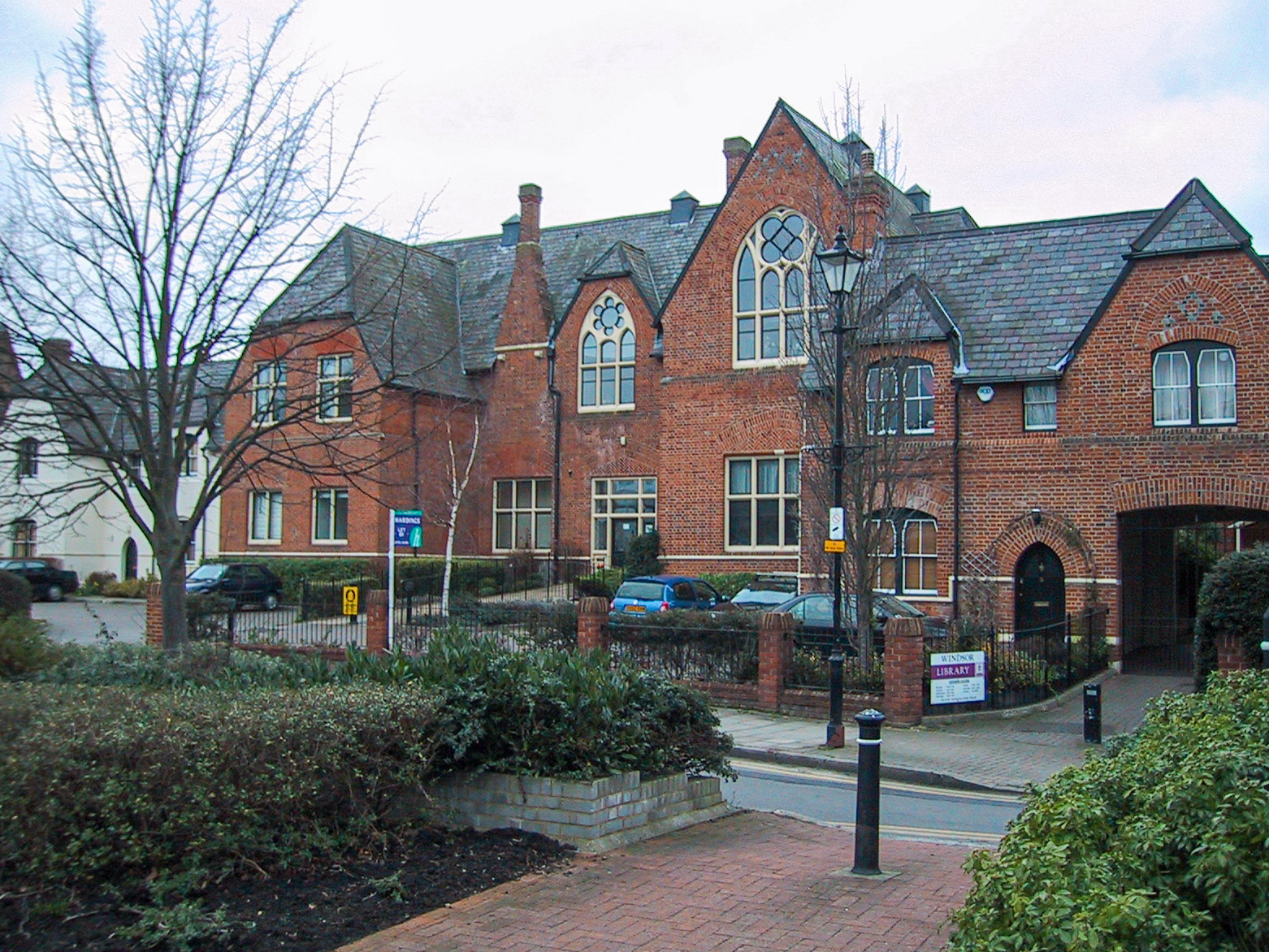
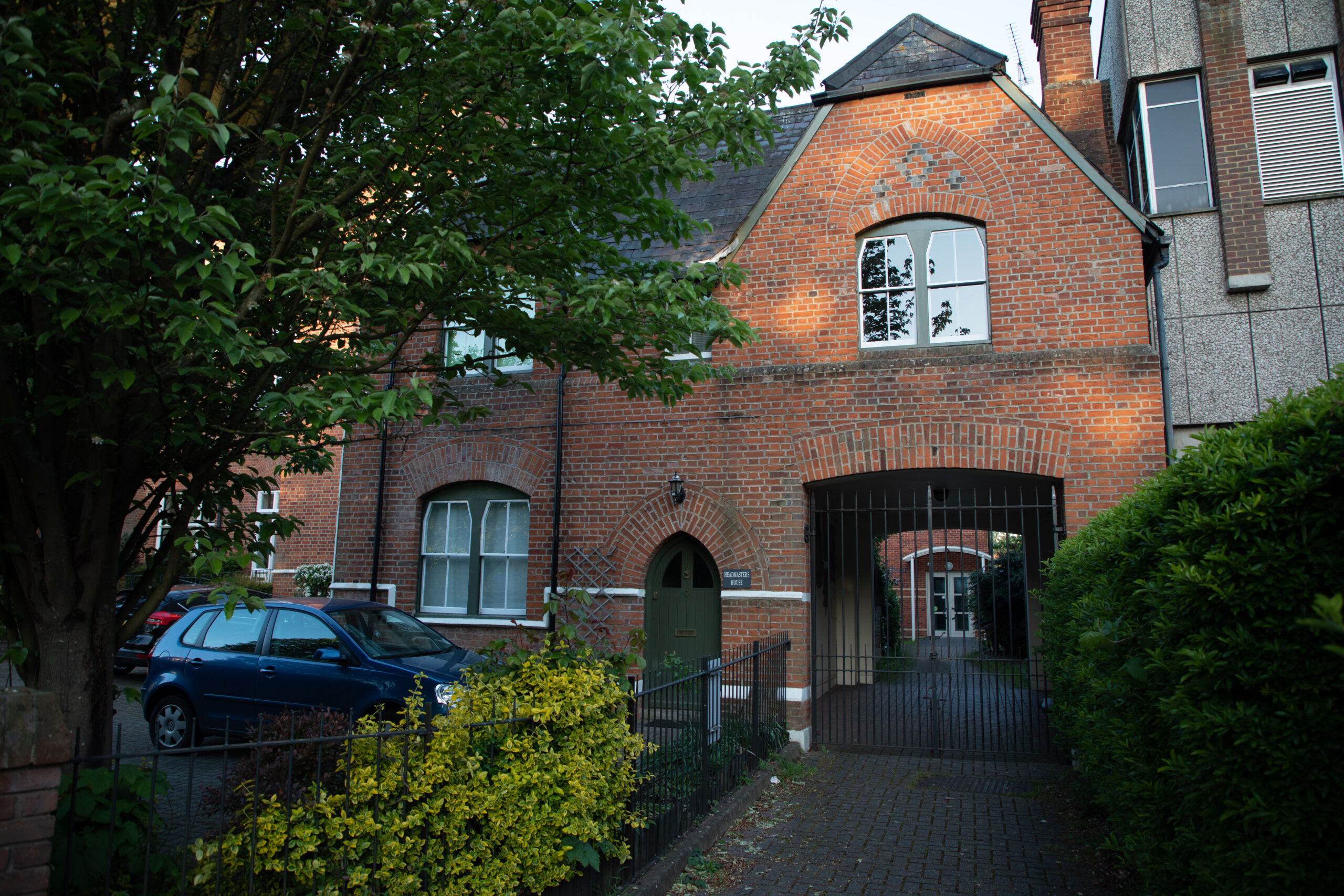
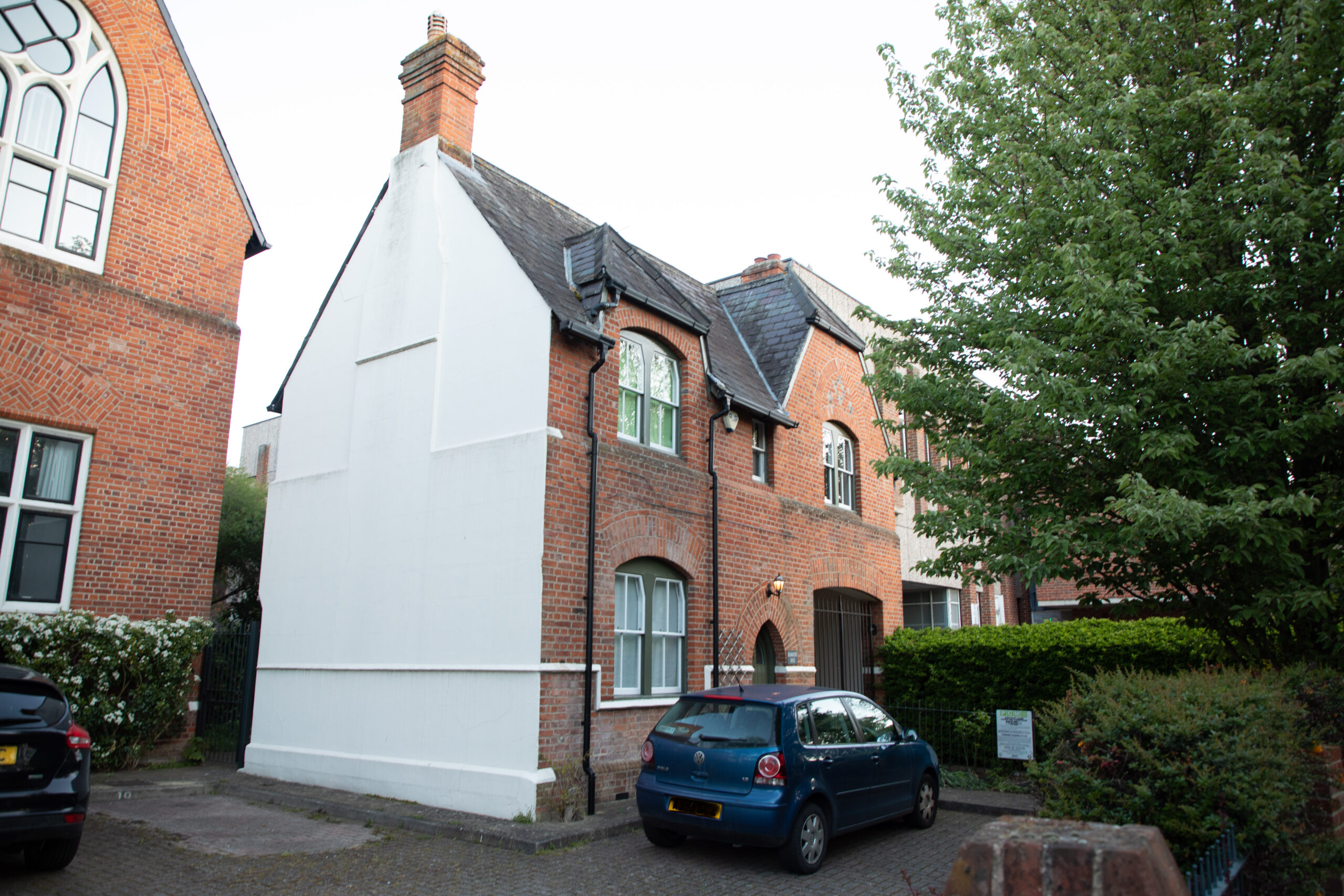
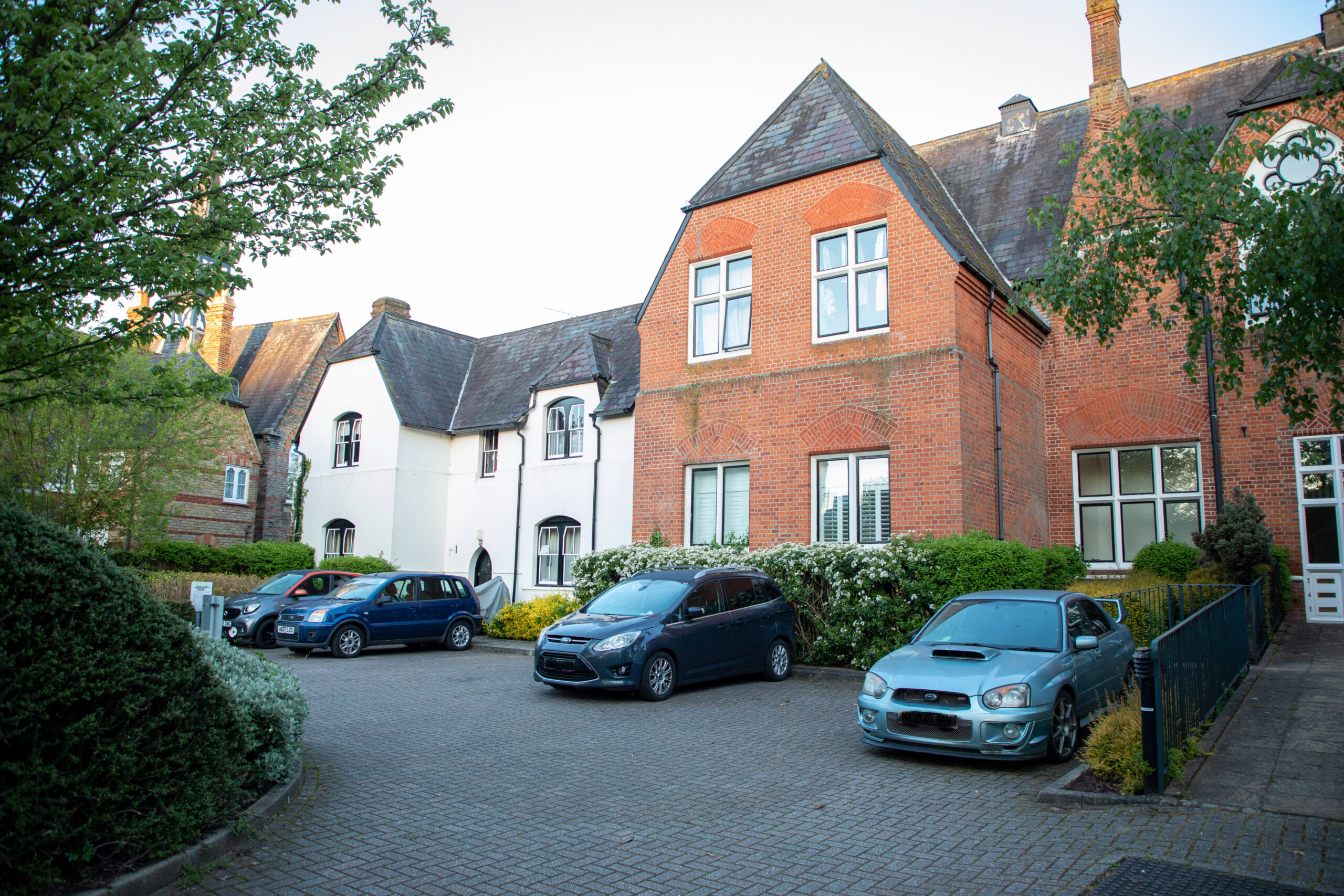
1861 29th September land was purchased for £500 and conveyed to the trustees to build a new school on Maids’ Acre, adjoining Bachelor’s Acre. Building started immediately the builders Fassnidge & Son from Uxbridge wrote in a letter on 3 December 1861 “Progressing as fast as weather will allow”. 1862 New building completed.
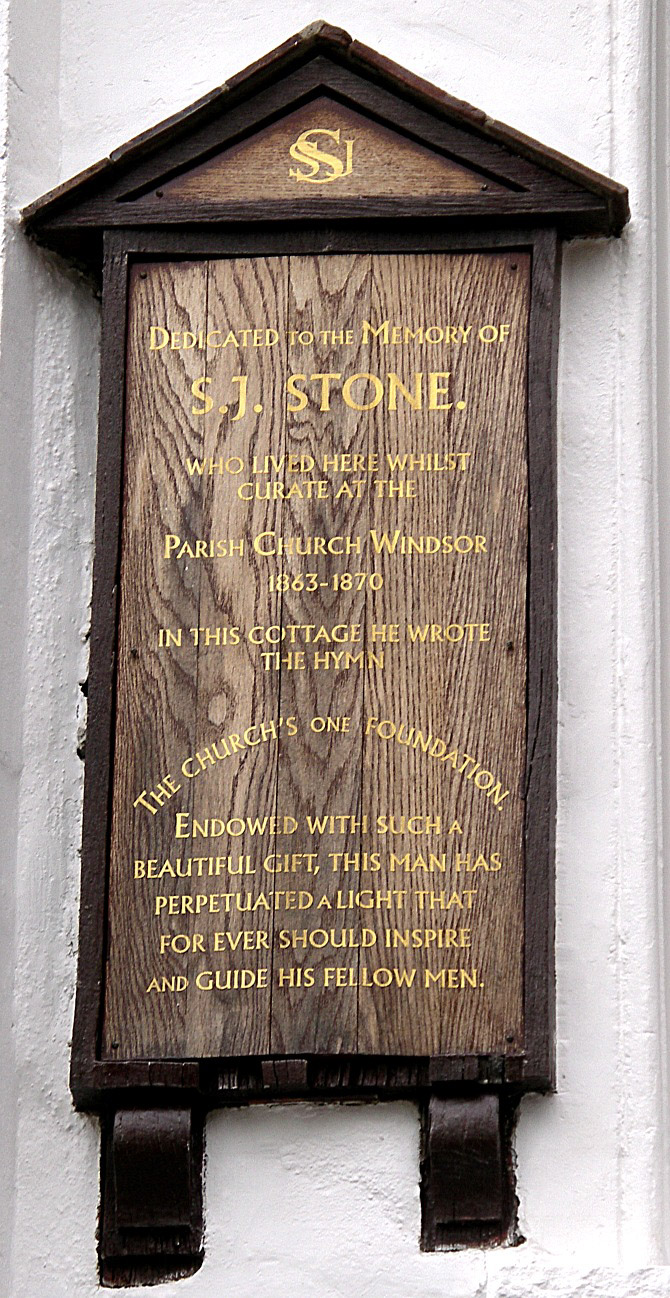
During the period 1863-1870 Western Cottage was occupied by S.J. Stone the Curate at the Parish Church. He was a well known Hymn writer and during his time at the cottage wrote the hymn “The Church’s one Foundation” to which Wesley’s tune is added A plaque recording his occupancy is on the cottage. According to another plaque in the wall, it was written in the little back room tucked under the eaves with a window overlooking the graveyard.
Alfred Young Nutt MVO, ISO, Architect, Crown Surveyor and Artist lodged with the Reverend S.J. Stone at Western Cottage when he first came to Windsor.
The Acre continued to be used for sports, but lack of maintenance led the Windsor and Eton Express to report on 4 January 1863: ‘The Acre is a Swamp! Our representative observed for one hour to see how many people wishing to cross the Acre went across the bog, and the answer was none. The sooner the Bachelors re-make the pathways the better.’ On 6 December that year the paper reported a Council meeting and readers’ letters on the subject, protesting against any infringement of the Bachelors’ rights on this ‘historic parcel of land’. One local resident wrote, ‘People have the undoubted right to cross the Acre in any direction their fancy leads. I have done so for 50 years and I sincerely hope future generations of Windsorians will always claim that same privilege and boldly assert their rights against all comers.’
In 1873 steps were taken to clean up the Acre, the contractor being Mr. Adcock. An old inhabitant was quick to point out that the Acre was outside the control of the Council, giving as evidence that the 1817 Enclosure Enquiry had ruled that the Acre should be left exactly as it was, and that the New Windsor and Dedworth Enclosure Act did not apply to it.
1873 Gates in memory of Charles knight were erected at the burial ground next to Western Cottage.
In 1878 The Windsor Volunteer Fire Brigade held its annual dinner at the Adelaide Hotel, when it was announced that only £10 more was needed to buy a steam “Merry-weather” engine, to replace the manual engine. The money was raised without difficulty. The new engine, capable of pumping three hundred gallons a minute, was brought down by rail to the South Western Station, where it was received by the Mayor and taken down to the riverside, for testing.
There was no proper fire station in the modern sense. The steam engine was kept at the official headquarters in Bachelors’ Acre, but the manual engine was at the police station in Sheet Street, and the fire escape was located in St. Albans’ Street.
In 1875 there was another incident. The people proposed to hold sports on the Acre. The mayor and corporation said it was their property, and threatened to take steps to stop the sports. The town clerk advised the corporation that when the inclosure took place in 1817, the whole of the land in the Acre became the property of the corporation, and that the corporation had it as free as any other property. But the mayor and town clerk did not have their way. The local newspaper says that the people “acting upon the conviction that the corporation had no right to interfere with them they held their sports . . .”
In November 1879, Mr. Sevenoakes announced that he had fitted up part of his premises at Acre House as public baths. These were, commented the Express, ‘a great desideratum to a town the size and importance of Windsor’. There were six.
For the rest of the 19th century, maintenance was poor, but the Acre continued to be used for events such as bonfires. In the 1880s, Wombwell’s Menagerie with its noisy wild animals in cages camped on the Acre, but they got bogged down and had to be dug out by Guards from the Barracks.
From 1875 the corporation laid claim to the land as if it was their own property without any right in the inhabitants to play games there. So much so that in 1903 the town council proposed to sell part of Bachelors’ Acre to the local infirmary. The Local Government Board sent an inspector to hold an inquiry. He took evidence which showed that the inhabitants still claimed the use of the land. Thereupon the Local Government Board refused to approve the sale because the building would be incompatible with the use by the inhabitants. After this inquiry, big improvements were made making the Acre into a sports ground.
Acre Burial Ground July 1886The motion which some time ago was put to the Town Council to deal with the Parish Burial Ground at the Acre was then withdrawn. It was freely acknowledged that the control of the spot rests with the Vicar and Churchwardens. Until the ground, by a faculty from the Bishop, ceases to be a churchyard, and becomes a common Recreation Ground, the Council have no duties whatever with regard to it. Old parishioners will feel strongly that with so much recreation ground open to the residents, it was not desirable to divert their old churchyard from its consecrated uses. The Barracks and the Schools alike cause misgiving as to the sober, quiet enjoyment that should be found within its walls. In the last few months, the enclosure has been carefully cleansed and weeded, and all paths reopened. The Vicar would be glad to be put in communication with any families having memorials there and would readily lend the key to any who would wish to visit the spot. In the summertime it will, on some known occasions, be thrown open for some hours.
In 1898 on the morning of Good Friday, Bachelors’ Acre was roped off, by order or the Borough Surveyor, an act which sparked off another row over the ownership of the land. The Town Clerk described the action taken as ‘a mistake in the right direction’, and in the following year the Council again decided to affirm its right to the area by closing access to it once a year. Good Friday was the day selected, and the Acre was chained off, with notices prominently displayed. Gangs of youths removed the chains and threw down the notice boards, The battle was to continue for three quarters of a century.
1902 There was an increase in the numbers attending the Infirmary. As a result, it was proposed the building on a different site. Bachelor’s acre was suggested and all the that was necessary was a vote in favour at the council meeting. However, Sir Joseph Devereaux. Objected. The mayor said. Pardon me, Sir Joseph. It is too late to go into that now. I don’t think so, said Sir Joseph. Alderman Clark then produced photographs of the narrow passages onto the acre and claimed that it was the only playground that some poor children had. Once again the acre was saved, and not for the last time.
In war-time the acre has served as a military training ground.
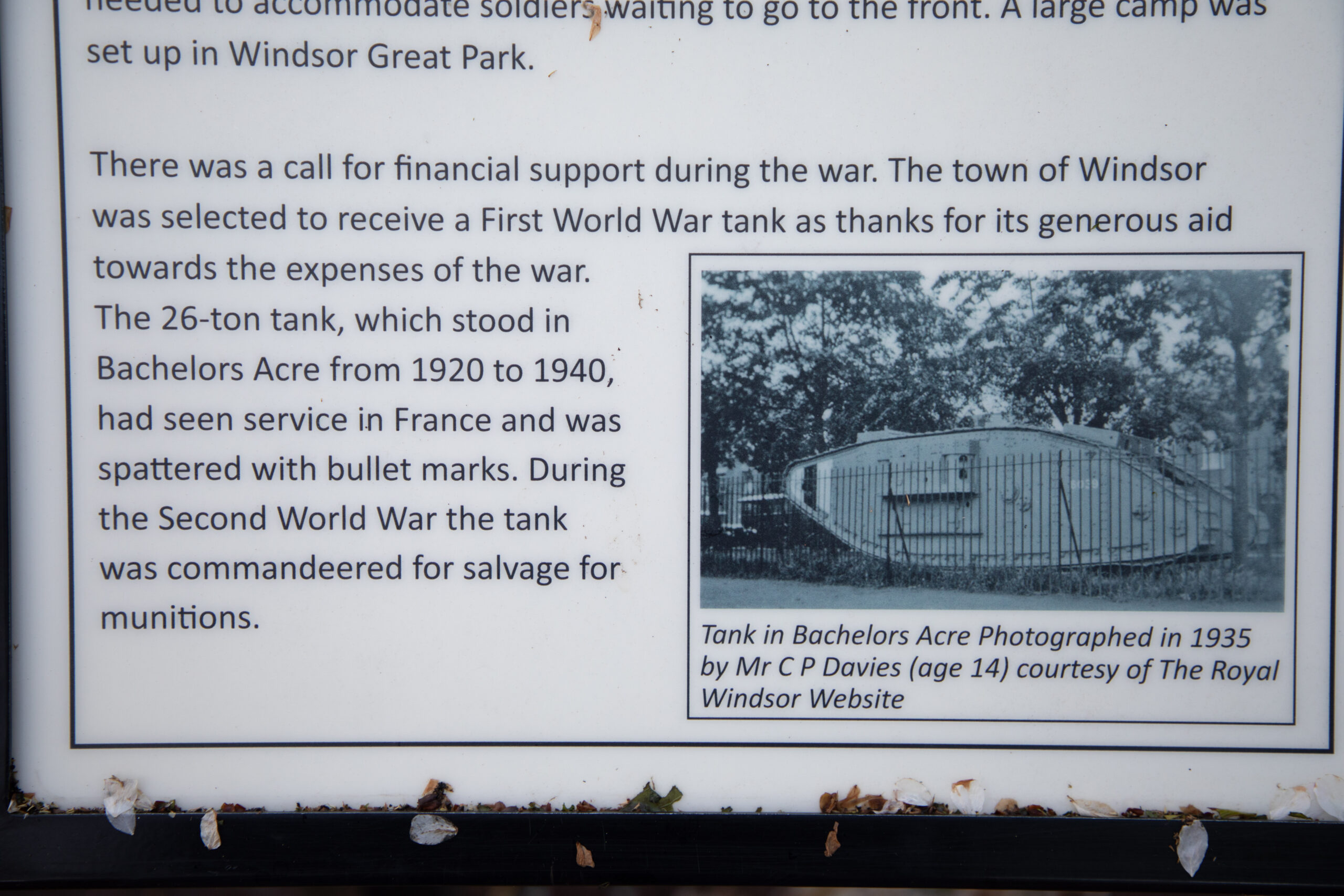
1920 A tank arrived, at bachelors acre with great ceremony. It was a gift from the War Department for the substantial amount of money collected for the war effort by Windsorians.
1922 The new telephone exchange was built on Bachelors Acre. The previous one on Datchet Road Closed.
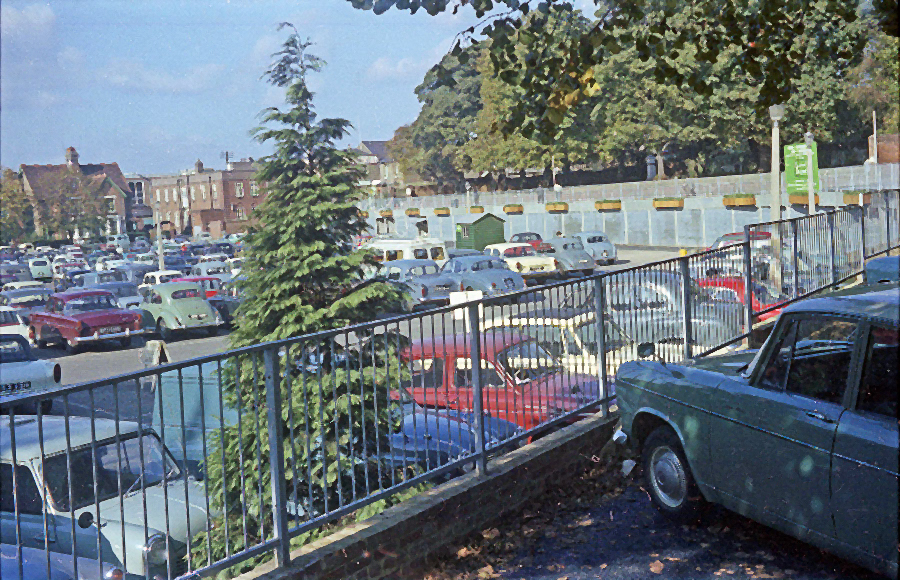
In 1936 at the time of the funeral of King George the IV that cars were parked on Bachelor’s Acre for the first time. This became a regular habit.
1940 The tank on Bachelors Acre was scrapped to help the war effort.
1945, eighth of May, the VE day. Victory in Europe Flags appeared in houses and shops and there were celebrations on Bachelor’s Acre, where the Mayor burned a Nazi flag.
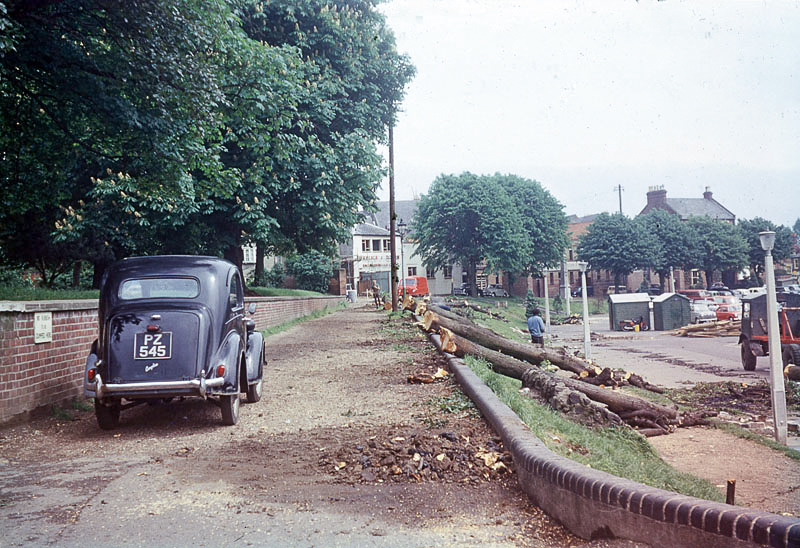
During the 1950’s little changed at the Acre, Adjoining Western Cottage, below the old graveyard, was a quiet pathway, over-shadowed by Lime trees. Alderman Thomas Dyson was in due course to call it Madeira Walk, and invalids were recommended by their doctors to take the air beneath the shady trees.
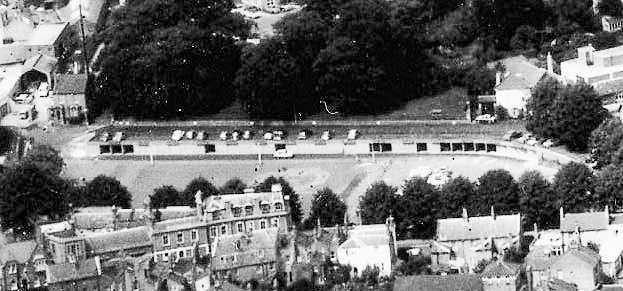
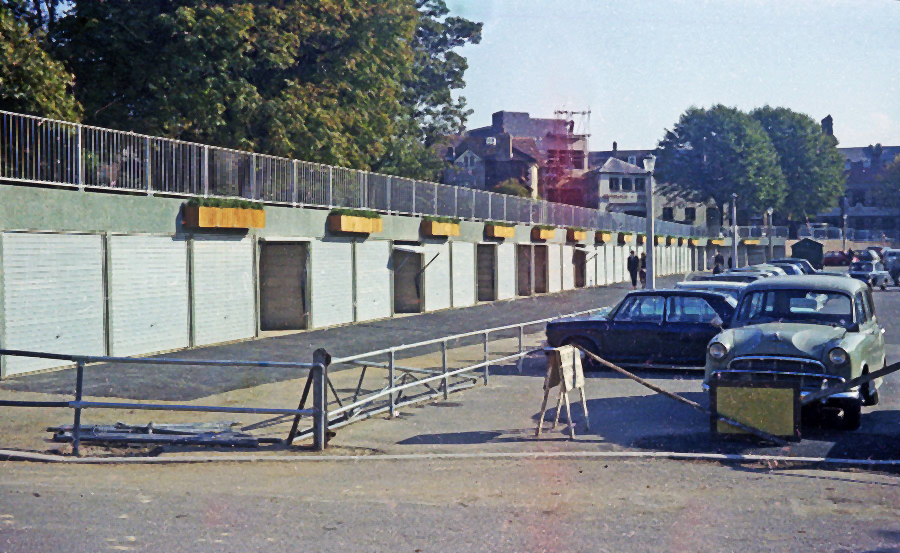
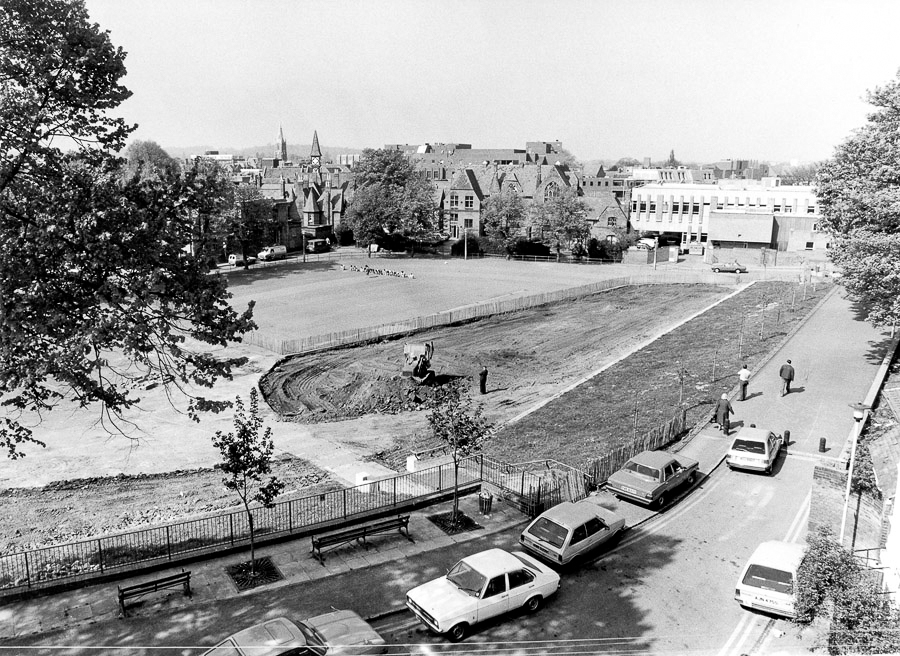
In the 1960’s The corporation began to see the income potential from the Acre and still refused to recognise any right for inhabitants to use the land for recreation. The corporation cut down the avenue of lime trees on the Northern perimeter in front of the Grave yard. This made way for a row of utilitarian lock-up garages for rent. The Acre was covered with tarmac and turned into a car park, the Royal Free School was allowed to use half Monday to Friday as a playground and at weekends and school holidays the whole Acre was used as a car park.
One annual event that did continue on the Acre during the 60’s was the 5th November Guy Fawkes bonfire. All the local children would collect anything that would burn from local houses and build a very large bonfire which was lit on 5th November. People would bring their fireworks and it was an amazing sight. Unfortunately it became so popular and dangerous that it had to be stopped.
1965 The Commons Registration Act, under which Doris Miller later registered Bachelors Acre as a town green, was passed by Parliament.
In 1968 the corporation actually proposed to put up a multi-storey car park, but in 1969 planning permission was turned down by Berkshire County Council. One of the reasons was because of the claim of right by the inhabitants to use it for recreation.
in 1971 the Windsor and Eton Society applied for the Acre to be registered as a Town Green under the Commons Registration Act 1965.
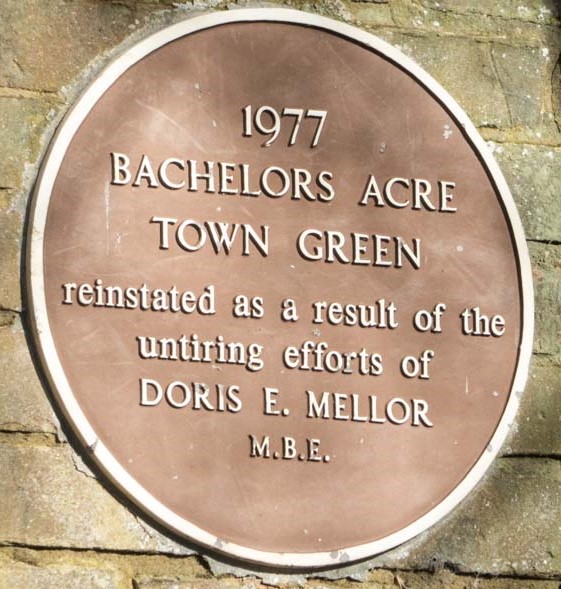
On 13 November 1972, the refusal to allow a multi-storey car park was upheld in the High Court, and by this time Miss Mellor had accumulated a significant amount of information about the history of the Acre to support the claim that it should be a Town Green.
The Royal Borough of New Windsor lodged an objection to that registration. It was referred to the Chief Commons Commissioner. He confirmed the registration. The borough appealed to Foster J [1974] 1 WLR 1504
New Windsor Corporation v Mellor [1975] 1 Ch 380, CA
The conclusion to this case was:
“On the whole of the evidence, I am satisfied that the customary right claimed is established, and that the commissioner’s decision should be upheld. . . .”
Brightman LJ I agree that this appeal should be dismissed for the reasons given in the judgments of Lord Denning MR and Browne LJ.”
More importantly, because of Miss Mellor’s campaign, supported by the Windsor and Eton Society, it is officially a Town Green, and as such is safe from future development.
The Royal Free Senior School relocated to Bourne Avenue in 1968 and the car park and garages were removed at some time after. Bachelors Acre was grassed over and made into a pleasant recreational area.
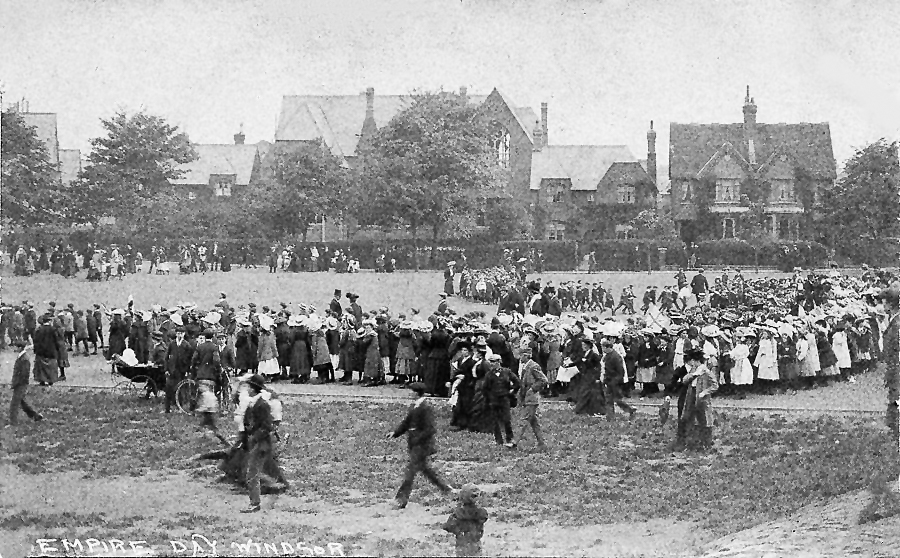
1977 The 700th anniversary of Windsor’s first charter coincided with the Queen’s Silver Jubilee year. There was a pageant of the history of Windsor involving children from all the schools in the town on Bachelor Acre.
Miss Doris Evelyn Mellor M.B.E.
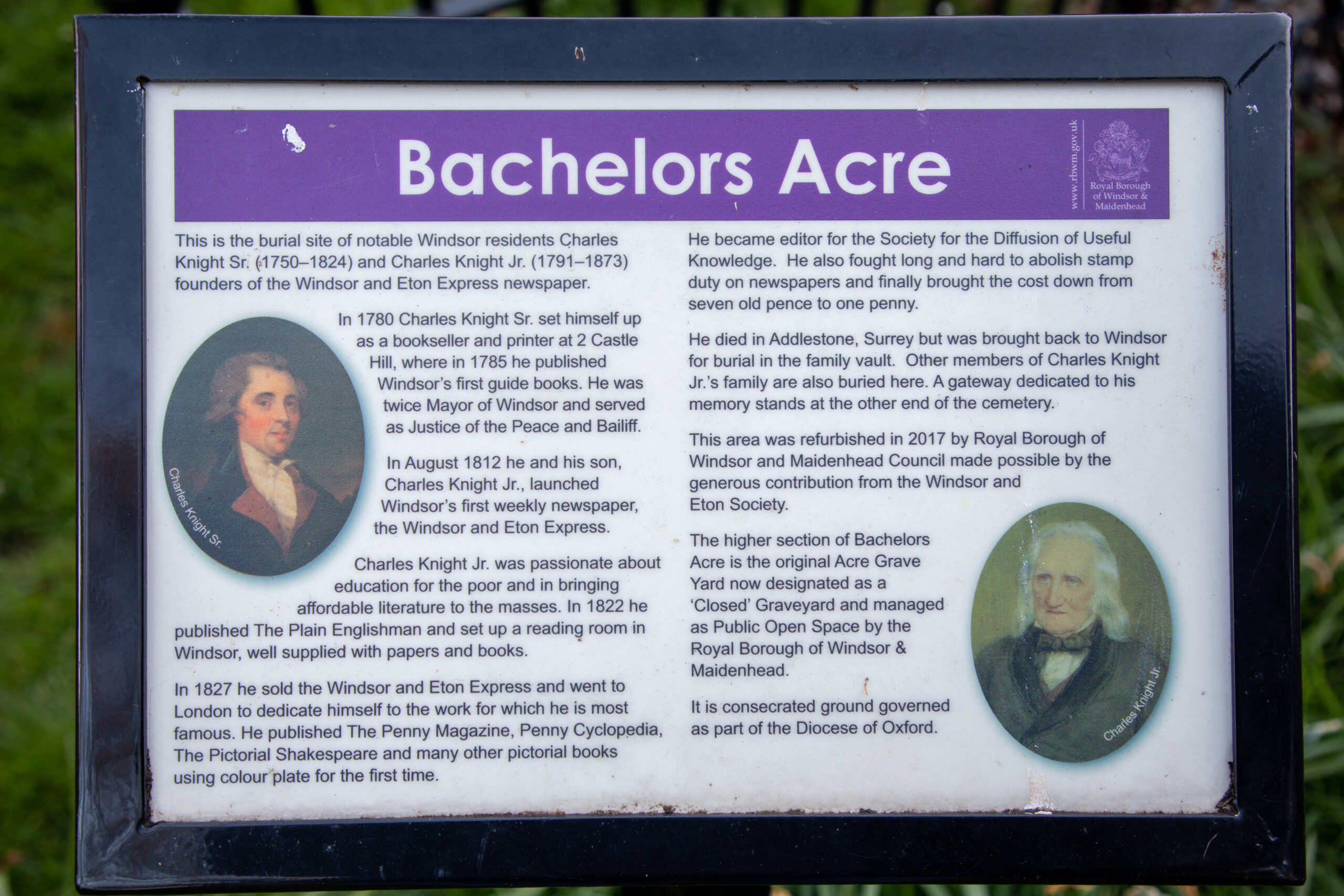
RBWM Bachelors Acre
Thamesweb The Old Burial Ground at Maderia Walk, Bachelors Acre
Thamesweb The Female Tank at Bachelor’s Acre 1920-1940
Charles Knight
The Infirmary Bachelors Acre